II
CHILDHOOD
1834-1843
"Sweete home, where meane estate
In safe assurance, without strife or hate,
Findes all things needfull for contentment
meeke."
-SPENSER.
Is there not in the bosoms of the wisest and
best some of the child's heart left to respond to its earliest
enchantments ? "-C. LAMB.
"I cannot paint to Memory's eye
The scene, the glance, I dearest love;
Unchanged themselves, in me they die,
Or faint, or false, their shadows prove."
-KEBLE.
Ce sont la' les sejours, les sites, les
rivages,
Dont mon ame attendrie evoque les images,
Et dont, pendant les nuits, mes songes les
plus beaux
Pour enchanter mes yeux composent leurs
tableaux."
-LAMARTI NE.
MARIA LEYCESTER had been married to my uncle Augustus Hare in
June 1829. In their every thought and feeling they were united,
and all early associations had combined to fit them more entirely
for each other's companionship. A descendant of one of the oldest
families in Cheshire, Miss Leycester's childhood and youth had
been spent almost entirely in country rectories, but in such
rectories as are rarely to be found, and which prove that the
utmost intellectual refinement and an interest in all that is
remarkable and beautiful in this world are not incompatible with
the highest aspirations after a Christian and a heavenly life.
Her father, Oswald Leycester, Rector of Stoke-upon-Terne in
Shropshire, was a finished scholar, had travelled much, and was
the most agreeable of companions. Her only sister, seven years
older than herself, was married when very young to Edward Stanley,
Rector of Alderley, and afterwards Bishop of Norwich, well known
for the picturesqueness of his imaginative powers, for his
researches in Natural History, and for that sympathy with all
things bright and pleasant which preserved in him the spirit of
youth quite to the close of life. Her most intimate friend, and
the voluntary preceptor of her girlhood, had been the gifted
Reginald Heber, who, before his acceptance of the Bishopric of
Calcutta, had lived as Rector of Hodnet - the poet-rector -
within two miles of her home.
One of the happy circle which constantly met at Hodnet Rectory,
she had known Augustus Hare (first-cousin of Mrs. Heber, who was
a daughter of Dean Shipley) since she was eighteen. Later
interests and their common sorrow in Heber's death had thrown
them closely together, and it would scarcely have been possible
for two persons to have proved each other's characters more
thoroughly than they had done, before the time of their marriage,
which was not till Maria Leycester was in her thirty-first year.
Four years of perfect happiness were permitted them - years
spent almost entirely in the quiet of their little rectory in the
singularly small parish of Alton Barnes amid the Wiltshire Downs,
where the inhabitants, less than two hundred in number, living
close at each other's doors, round two or three small pastures,
grew to regard Augustus Hare and his wife with the affection of
children for their parents. So close was the tie which united
them, that, when the rich family living of Hurstmonceaux fell
vacant on the death of our great-uncle Robert, Augustus Hare
could not bear to leave his little Alton, and implored my father
to persuade his brother Julius to give up his fellowship at
Trinity and to take it instead.
"Having lived but little in the country, and his
attention having been engrossed by other subjects, Augustus Hare
was, from education and habits of life, unacquainted with the
character and wants of the poor. The poverty of their minds,
their inability to follow a train of reasoning, their prejudices
and superstitions, were quite unknown to him. All the usual
hindrances to dealing with them, that are commonly ascribed to a
college life, were his in full force. But his want of experience
and knowledge touching the minds and habits of the poor were
overcome by the love he felt towards all his fellow-creatures,
and his sympathy in all their concerns. In earlier days this
Christ-like mind had manifested itself towards his friends,
towards servants, towards all with whom he was brought in contact.
It now taught him to talk to his poor parishioners and enter into
their interests with the feeling of a father and a friend. . . He
had the power of throwing himself out of himself into the
interests and feelings of others; nor did he less draw out their
sympathies into his own, and make them sharers in his pleasures
and his concerns. It was not only the condescension of a superior
to those over whom he was placed, it was far more the mutual
interchange of feeling of one who loved to forget the difference
of station to which each was called, and to bring forward the
brotherly union as members of one family in Christ, children of
the same Heavenly Father, in which blessed equality all
distinctions are done away. Often would he ask their counsel in
matters of which he was ignorant, and call upon their sympathy in
his thankful rejoicing. His garden, his hayfield, his house, were
as it were thrown open to them, as he made them partakers of his
enjoyment, or sought for their assistance in his need. . . . The
one pattern ever before his eyes was his Lord and Master Jesus
Christ; the first question he asked himself, 'What would Jesus
Christ have me to do? What would He have done in my place?'
"Perfect contentedness with what was appointed for him,
and deep thankfulness for all the good things given him, marked
his whole being. In deciding what should be done, or where he
should go, or how he should act, the question of how far it might
suit his own convenience, or be agreeable to his own feelings,
was kept entirely in the background till all other claims were
satisfied. It was not apparently at the dictate of duty and
reason that these thoughts were suppressed and made secondary: it
seemed to be the first, the natural feeling in him, to seek first
the things of others and to do the will of God, and to look at
his own interest in the matter as having comparatively nothing to
do with it. And so great a dread had he of being led to any
selfish or interested views, that he would find consolation in
having no family to include in the consideration- 'Had I had
children I might have fancied it an excuse for worldly-mindedness
and covetousness.' His children truly were his fellow-men, those
who were partakers of the same flesh and blood, redeemed by the
same Saviour, heirs of the same heavenly inheritance. For them he
was willing to spend and be spent, for them he was covetous of
all the good that might be obtained. . . . He was never weary in
well-doing, never thought he had done enough, never feared doing
too much. Those small things, which by so many are esteemed as
unnecessary, as not worth while, these were the very
things he took care not to leave undone. It was not rendering a
service when it came in his way, when it occurred in the
natural course of things that he should do it; it was going out
of the way to help others, taking every degree of trouble and
incurring personal inconvenience for the sake of doing good, of
giving pleasure even in slight things, that distinguished his
benevolent activity from the common form of it. The love that
dwelt in him was ready to be poured forth on whomsoever needed it,
and being a free-will offering, it looked for no return, and felt
no obligation conferred."
I have copied these fragments from the portrait which Augustus
Hare's widow drew of his ministerial life,1 because they afford the best clue to the way
in which that life influenced hers, drawing her away from earth
and setting her affections in heavenly places. And yet, though in
one sense the life of Augustus Hare and his wife at Alton was one
of complete seclusion, in another sense there were few who lived
more for, or who had more real communion with, the scattered
members of their family. Mrs. Stanley and her children, with her
brother Mr. Penrhyn2 and his wife, were sharers by
letter in every trifling incident which affected their sister's
life; and with his favourite brother Julius, Augustus Hare never
slackened his intellectual intercourse and companionship. But
even more than these was Lucy Anne Stanley3 the life-long friend of Maria Hare, till, in
the summer of 1833, the tie of sisterhood, which had always
existed in feeling, became a reality, through her marriage with
Marcus Hare, the youngest of the four brothers.
A chill which Augustus Hare caught when
he was in Cheshire for his brother's marriage, was the first
cause of his fatal illness. It was soon after considered
necessary that he should spend the winter abroad with his wife,
and it was decided that they should accompany Marcus and Lucy
Hare to Rome. At Genoa the illness of Augustus became alarming,
but he reached Rome, and there he expired on the 14th of February
1834, full of faith and hope, and comforting those who surrounded
him to the last.
My father felt his brother's loss deeply.
They had little in common on many points, yet the close tie of
brotherhood, which had existed between them from early days at
Bologna, was such as no difference of opinion could alter, no
time or absence weaken. When Augustus was laid to rest at the
foot of the pyramid of Caius Cestius, my father's most earnest
wish was to comfort his widowed sister-in-law, and in the hope of
arousing an interest which might still give some semblance of an
earthly tie to one who seemed then upon the very borderland of
heaven, he entreated, when I was born in the following month,
that she would become my godmother, promising that she should be
permitted to influence my future in any way she pleased, and
wishing that I should be called Augustus after him she had lost.
I was baptized on the 1st of April in the
Villa Strozzi, by Mr. Burgess. The widow of Augustus held me in
her arms, and I received the names of "Augustus John
Cuthbert," the two last from my godfathers (the old Sir John
Paul and Mr. Cuthbert Ellison), who never did anything for me,
the first from my godmother, to whom I owe everything in the
world.
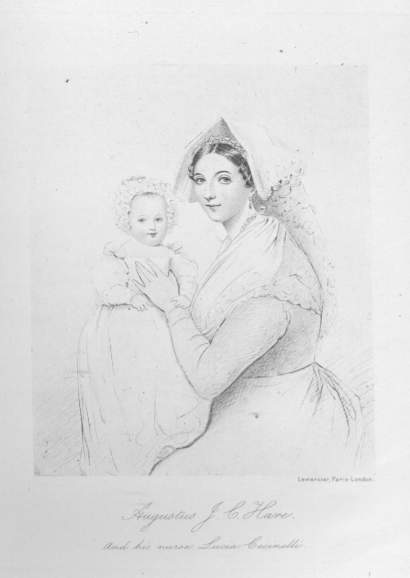
Soon afterwards, my godmother returned to
England, with her faithful maid Mary Lea, accompanied by the
Marcus Hares. She had already decided to fix her future home in
the parish of Julius, who, more than any other, was a fellow-mourner
with her. As regarded me,. nothing more than the tie of a
godmother had to that time been thought of; but in the quiet
hours of her long return journey to England, while sadly looking
forward to the solitary future before her, it occurred to
Augustus Hare's widow as just possible that my parents might be
induced to give me up to her altogether, to live with her as her
own child. In July she wrote her petition, and was almost
surprised at the glad acceptance it met with. Mrs. Hare's answer
was very brief – "My dear Maria, how very kind of you!
Yes, certainly, the baby shall be sent as soon as it is weaned;
and, if any one else would like one, would you kindly recollect
that we have others."
Yet my adopting mother had stipulated
that I was to be altogether hers; that my own relations were
henceforward to have no claim over me whatever; that her parents
were to be regarded as my grandparents, her brother and sister as
my uncle and aunt.
Meantime my father took his family for
the hot summer months to one of the lovely villas on the high
spurs of volcanic hill, which surround picturesque romantic Siena.
They had none of the English society to which they had been
accustomed at Lucca Baths and at Castellamare, but the Siennese
are celebrated for their hospitality, and my father's talents,
famous then throughout Italy, ensured him a cordial welcome
amongst the really cultivated circle which met every evening in
the old medieval palaces of the native nobility. Of English, they
had the society of Mr and Mrs. Bulwer, who were introduced by
Landor; while constant intercourse with Landor himself was one of
the chief pleasures which the family enjoyed during this and many
succeeding years. With Francis Hare he laid the plan of many of
his writings, and in his judgment and criticism he had the
greatest confidence. To this he alludes in his little poem of
"Sermonis Propriora:" -
"Little do they who glibly
talk of verse
Know what they talk about, and what
is worse,
Think they are judges if they dare
to pass
Sentence on higher heads.
.....................................The mule and ass
Know who have made them what they
are, and heed
Far from the neighing of the
generous steed.
Gell, Drummond, Hare, and wise and
witty Ward
Knew at first sight and sound the
genuine bard,
But the street hackneys, fed on
nosebag bran,
Assail the poet, and defame the man."
After another winter at Rome, the family
went to Lausanne, and thence my father, with my beautiful
Albanese nurse, Lucia Cecinelli, took me to meet Mrs. Gayford,
the English nurse sent out to fetch me by my adopted mother from
Mannheim on the Rhine. There the formal exchange took place which
gave me a happy and loving home. I saw my father afterwards, but
he seldom noticed me. Many years afterwards I knew Mrs. Hare well
and had much to do with her; but I have never at any time spoken
to her or of her as a "mother," and I have never in any
way regarded her as such. She gave me up wholly and entirely. She
renounced every claim upon me, either of affection or interest. I
was sent over to England with a little green carpet-bag
containing two little white night-shirts and a red coral necklace-my
whole trousseau and patrimony. At the same time it was indicated
that if the Marcus Hares should also wish to adopt a child, my
parents had another to dispose of: my second brother William had
never at any time any share in their affections.
On reaching England I was sent first to
my cousin the Dowager Countess of Strathmore, and from her house
was taken (in the coach) by Mrs. Gayford to my mother - my real
only mother from henceforth - at Hurstmonceaux Rectory, which at
that time was as much a palace of art, from its fine collection
of pictures and books, as a country rectory could be.
My adopted mother always used to say that
the story of Hannah reminded her of the way in which I was given
to her. She believed it was in answer to a prayer of my uncle
Augustus in the cathedral at Chalons, when he dropped some money
into a box "pour les femmes enceintes," because he knew
how much she wished to have a child. His eldest brother's wife
was then enceinte, and I was born soon afterwards.
From MY MOTHER'S JOURNAL.
"On Tuesday, August 26, 1835, my
little Augustus came to me. It was about four o'clock when I
heard a cry from upstairs and ran up. There was the dear
child seated on Mary's (Mary Lea's) knee, without a frock. He
smiled most sweetly and with a peculiar archness of
expression as I went up to him, and there was no shyness.
When dressed, I brought him down into the drawing-room: he
looked with great delight at the pictures, the busts, and
especially the bronze wolf, pointed at them, then looked
round at Jule and me. When set down, he strutted along the
passage, went into every room, surveyed all things in it with
an air of admiration and importance, and nothing seemed to
escape observation. The novelty of all around and the
amusement he found at first seemed to make him forget our
being strangers. The next day he was a little less at home.
His features are much formed and an uncommon intelligence of
countenance gives him an older look than his age: his dark
eyes and eyelashes,
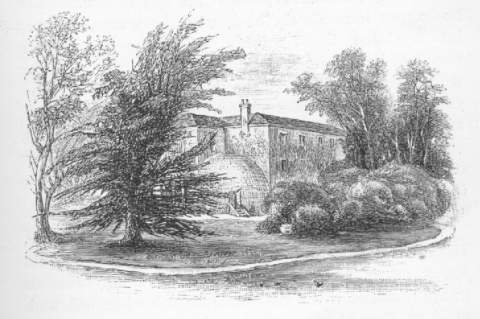
HURSTMONCEAUX RECTORY.
well - formed nose and expressive
mouth make his face a very pretty one; but he has at present
but little hair and that very straight and light. His limbs
are small and he is very thin and light, but holds himself
very erect. He can run about very readily, and within a week
after coming could get upstairs by himself. In talking, he
seems to be backward, and except a few words and noises of
animals, nothing is intelligible. Number seems to be a great
charm to him - a great many apples, and acorns to be put in
and out of a basket. He has great delight in flowers, but is
good in only smelling at those in the garden, gathers all he
can pick up in the fields, and generally has his hands full
of sticks or weeds when he is out. He wants to be taught
obedience, and if his way is thwarted or he cannot
immediately have what he wants, he goes into a violent fit of
passion. Sometimes it is soon over and he laughs again
directly, but if it goes on he will roll and scream on the
floor for half-an-hour together In these cases we leave him
without speaking, as everything adds to the irritation, and
he must find out it is useless. But if by prevention such
a fit may be avoided it is better, and Mary Lea is very
ingenious in her preventing."
"Oct. 3. - Augustus
improves in obedience already. His great delight is in
throwing his playthings into a jug or tub of water. Having
been told not to do so in my room, he will walk round the tub
when full, look at Mary, then at me, and then at the tub with
a most comical expression, but if called away before too long
will resist the temptation. He is very impatient, but sooner
quiet than at first: and a tear in one eye and a smile in the
other is usually to be seen. His great delight lately has
been picking up mushrooms in the fields and filling his
basket."
It was in October that my mother moved
from the Rectory to Lime - our own dear home for the next five-and-twenty
years. Those who visit Hurstmonceaux now can hardly imagine Lime
as it then was, all is so changed. The old white gabled house,
with clustered chimneys and roofs rich in colour, rose in a
brilliant flower-garden sheltered on every side by trees, and
separated in each direction by several fields from the highroad
or the lanes. On the side towards the Rectory, a drive between
close walls of laurel led to the old-fashioned porch which opened
into a small low double hall. The double drawing-room and the
dining-room, admirably proportioned, though small, looked across
the lawn, and one of the great glistening pools which belonged to
an old monastery (once on the site of the house), and which lay
at the foot of a very steep bank carpeted with primroses in
spring. Beyond the pool was our high field, over which the stumpy
spire of the church could be seen, at about a mile and a half
distant, cutting the silver line of the sea. The castle was in a
hollow farther still and not visible. On the right of the lawn a
grass walk behind a shrubbery looked out upon the wide expanse of
Pevensey Level with its ever varying lights and shadows, and was
sheltered by the immensely tall abele trees, known as "the
Five Sisters of Lime," which tossed their weird arms,
gleaming silver-white, far into the sky, and were a feature in
all distant views of Hurstmonceaux. On the left were the offices,
and a sort of enclosed court, where the dogs and cats used to
play and some silver pheasants were kept, and where my dear nurse
Mary Lea used to receive the endless poor applicants for charity
and help, bringing in their many complaints to my mother with
inimitable patience, though they were too exclusively self-contained
to be ever the least grateful to her, always regarding and
speaking of her and John Gidman, the butler, as "furriners,
folk from the shires."
No description can give an idea of the
complete seclusion of the life at Lime, of the silence which was
only broken by the cackling of the poultry or the distant
threshing in the barn, for the flail, as well as the sickle and
scythe, were then in constant use at Hurstmonceaux, where oxen -
for all agricultural purposes - occupied the position which
horses hold now. No sound from the "world," in its
usually accepted sense, would ever have penetrated; if it had not
been for the variety of literary guests who frequented the
Rectory, and one or other of whom constantly accompanied my uncle
Julius when he came down, as he did every day of his life, to his
sister-in-law's quiet six-o'clock dinner, returning at about
eight. Of guests in our house itself there were very few, and
always the same - the Norwich Stanleys; Miss Clinton, a dear
friend
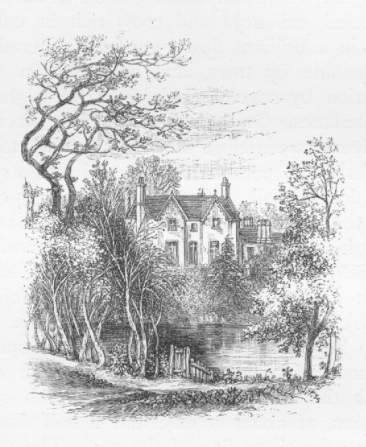
LIME.
of my mother; after a time the Maurices,
and Mr. and Mrs. Pile - an Alton farmer of the better class, and
his excellent wife: but there was never any variety. Yet in my
boyhood I never thought it dull, and loved Lime with passionate
devotion. Even in earliest childhood my dearest mother treated me
completely as her companion, creating interests and amusements
for me in all the natural things around, and making me so far a
sharer in her own spiritual thoughts, that I have always felt a
peculiar truthfulness in Wordsworth's line –
"Heaven lies about us in
our infancy."
If my mother was occupied, there was
always my dear "Lea" at hand, with plenty of farmhouse
interests to supply, and endless homely stories of country life.
From MY MOTHER'S JOURNAL.
"Lime, Oct. 23, 1835.-My
little Augustus was much astonished by the change of house,
and clung to me at first as if afraid of moving away. The
first evening he kissed me over and over again, as if to
comfort and assure me of his affection."
"Nov. 21.-Augustus has
grown much more obedient, and is ready to give his food or
playthings to others. Some time ago he was much delighted
with the sight of the moon, and called out 'moon, moon,'
quite as if he could not help it. Next day he ran to the
window to look for it, and has ever since talked of it
repeatedly. At Brighton he called the lamps in the streets 'moon,'
and the reflection of the candles or fire on the window he
does the same. He is always merriest and most amiable when
without playthings: his mind is then free to act for itself
and finds its own amusement; and in proportion as his
playthings are artificial and leave him nothing to do, he
quarrels or gets tired of them. He takes great notice of
anything of art - the flowers on the china and plates, and
all kinds of pictures.
"Stoke Rectory, Jan. 7, 1836.
- During our stay with the Penrhyns at Sheen, Baby was so
much amused by the variety of persons and things to attract
attention, that he grew very impatient and fretful if
contradicted. Since we have been at Stoke he has been much
more gentle and obedient, scarcely ever cries and amuses
himself on the floor. He is greatly amused by his Grandpapa's
playful motions and comical faces, and tries to imitate them.
When the school children are singing below, he puts up his
forefinger when listening and begins singing with his little
voice, which is very sweet. He will sit on the bed and talk
in his own way for a long time, telling about what he has
seen if he has been out: his little mind seems to be working
without any visible thing before it, on what is absent."
"Alderley, March 13. - My
dear boy's birthday, two years old. He has soon become
acquainted with his Alderley relations,4 and learnt to call them by name.
He has grown very fond of 'Aunt Titty,' and the instant she
goes to her room follows her and asks for the brush to brush
the rocking-horse and corn to feed it. His fits of passion
are as violent, but not so long in duration, as ever. When he
was roaring and kicking with all his might and I could
scarcely hold him, I said – 'It makes Mama very sorry to
see Baby so naughty.' He instantly stopped, threw his arms
round my neck, and sobbed out – 'Baby lub Mama - good.'
When I have once had a struggle with him to do a thing, he
always recollects, and does it next time."
"Lime, June 13. - On the
journey from Stoke to London, Baby was very much delighted
with the primroses in the hedgerows, and his delight in the
fields when we got home was excessive. He knows the name of
every flower both in garden and field, and never forgets any
he has once seen. . . . When he sees me hold my hand to my
head, he says, 'Mama tired-head bad - Baby play self.'"
"July 9. - Baby can now
find his way all over the house, goes up and down stairs
alone and about the lawn and garden quite independently, and
enjoys the liberty of going in and out of the windows: runs
after butterflies or to catch his own shadow: picks up
flowers or leaves, and is the picture of enjoyment and
happiness. Tumbling out of the window yesterday, when the
fright was over, he looked up – 'Down comes Baby and
cradle and all.' He tells the kitten 'not touch this or that,'
and me 'not make noise, Pussy's head bad.'"
"Sept. 28. - The sea-bathing
at Eastbourne always frightened Baby before he went in. He
would cling to Mary and be very nervous till the women had
dipped him, and then, in the midst of his sobs from the shock,
would sing 'Little Bo Peep,' to their great amusement. He was
very happy throwing stones in the water and picking up shells;
but above all he enjoyed himself on Beachy Head, the fresh
air and turf seemed to exhilarate him as much as any one, and
the picking purple thistles and other down flowers was a
great delight. . . His pleasure in returning home and seeing
the flowers he had left was very great. He talks of them as
if they were his playmates, realising Keble's – 'In
childhood's sports, companions gay.'"
"Oct 17. - After dinner
to-day, on being told to thank God for his good dinner, he
would not do it, though usually he does it the first thing on
having finished. I would not let him get out of his chair,
which enraged him, and he burst into a violent passion. Twice,
when this abated, I went to him and tried, partly by
encouragement, partly by positively insisting on it, to bring
him to obedience. Each time I took him up from the floor, he
writhed on the floor again with passion, screaming as loud as
he could. After a while, when I had left him and gone into
the drawing-room, he came along the walk and went back again
two or three times as if not having courage to come in, then
at last came and hid his face in my lap. I carried him back
to the dining-room and put him in his chair and talked to him
about his dinner, did not he love God, for giving him so many
good things, and I knelt by him and prayed God to forgive him
for being so naughty and to take away the naughty spirit. All
the time he was struggling within himself, half-sobbing, half-smiling
with effort – 'I can't say it' - and then, after a time,
'Mama thanks God for Baby's good dinner.' 'No,' I said, 'Baby
must do it for himself.' Still he resisted. At length on
getting down from the chair he said, 'Kneel down under table'
- and there at last he said, 'Thank God for Baby's good
dinner,' and in a minute all the clouds were gone and
sunshine returned to his face. The whole struggle lasted I
suppose half-an-hour. In a few minutes after he was calling
me 'Mama dear' and as merry as ever."
"Stoke Rectory, Nov. 26.
- Baby asks 'Who made the dirt? Jesus Christ?' It is evident
that he has not the slightest notion of any difference
between the nature of God and any man, or between Heaven and
London or any name of a place. Perhaps in this simplicity and
literality of belief he comes nearer the truth than we in the
sophistications and subtleties of our reasonings on such
things: but the great difficulty is to impress awe and
reverence for a holy and powerful Being, and to give the
dread and serious sense of being under His eye, without a
slavish fear and distance.
"He always asks when he sees my
Bible – 'Mama reading about Adam and Eve and Jesus
Christ?' – a union of the two grand subjects, very
unconsciously coming to the truth."
"Jan 16, 1837. - Time is
as yet a very indistinct impression on Baby's mind. Going
round the field, he gathered some buttercups. I said, 'Leave
the rest till to-morrow.' When we returned the same
way, he asked 'Is it to-morrow now?' . . . After a violent
passion the other day he looked up – 'Will Jesus Christ
be shocked?' He comes often and says – 'Will 'ou pray
God to make little Augustus good?' and asks to 'pray with
Mama.'
"The other day he said – 'My
eyes are pretty.' 'Oh yes,' I said, 'they are, and so are
Mama's and Na's.' – 'And Grandpapa's and Grannie's too?'
– 'Yes, they are all pretty, nothing so pretty as eyes.'
And I have heard no more of it.
" 'Look, Mama,' he says, 'there
is a bird flying up to God.' – 'Where have you been to,
Baby ?' – 'To a great many wheres.' He visits all the
flowers in Grannie's garden, quite as anxiously as if they
were living beings, and that quite without any hope of
possessing them, as he is never allowed to gather any. He
puts the different flowers together - and invents names for
them – Hep – poly - primrose, &c. He also talks
to animals and flowers as if they were conscious, and in this
way creates constant amusement for himself: but the illusion
is so strong he hardly seems to separate it from fact, and it
becomes increasingly necessary to guard against the confusion
of truth and error."
Children are said seldom to remember
things which happen when they are three years old; but I have a
distinct recollection of being at my mother's early home of Toft
in Cheshire during this spring of 1837, and of the charm, of
which children are so conscious, of the Mrs. Leycester ("Toft
Grannie" - my mother's first cousin - who lived there. I
also recollect the great dog at Alderley, and being whipped by
"Uncle Ned" (Edward Stanley) at the gate of the Dutch
garden for breaking off a branch of mezereon when I was told not
to touch it. Indeed I am not sure whether these recollections are
not of a year before, in which I distinctly remember a terrible
storm at Lime, when Kate Stanley was with us, seeing a great
acacia-tree torn up by the roots and hurled against the drawing-room
window, smashing all before it, and the general panic and flight
that ensued. Otherwise my earliest impressions of Hurstmonceaux
are all of the primroses on the Lime bank - the sheets of golden
stars everywhere, and the tufts of pure white primroses which
grew in one particular spot, where the bank was broken away under
an old apple-tree. Then of my intense delight in being taken in a
punt to the three islets on the pond - Mimulus Island, Tiny and
Wee; and of the excessive severity of Uncle Julius, who had the
very sharpest possible way of speaking to children, even when he
meant to be kind to them. Every evening, like clockwork, he
appeared at six to dine with my mother, and walked home after
coffee at eight. How many of their conversations, which I was
supposed neither to hear or understand, have come back to me
since like echoes: strange things for a child to remember - about
the Fathers, and Tract XC., and a great deal about hymns and hymn-tunes
– "Martyrdom," "Irish" "Abridge,"
&c.; for an organ was now put into the church, in place of
the band, in which the violin never could keep time with the
instruments. Sir George Dasent has told me how he was at
Hurstmonceaux then, staying with the Simpkinsons. Arthur Stanley
was at the Rectory as a pupil, and he asked Arthur how he liked
this new organ. "Well," he said, "it is not so bad
as most organs, for it does not make so much sound." Uncle
Julius preached about it, altering a text into "What went ye
out for to hear."
A child who lives much with its elders is
almost certain to find out what it is most intended to conceal
from it. If possible it had better be confided in. I knew exactly
what whispers referred to a certain dark passage in the history
of the Rectory before Uncle Julius's time – "il y avait
un crime" - and I never rested till I found it out. It was
about this time that I remember Uncle Julius going into one of
his violently demonstrative furies over what he considered the
folly of "Montgomery's Poems," and his flinging the
book to the other end of the room in his rage with it, and my
wondering what would be done to me if I ever dared to be "as
naughty as Uncle Jule."
From MY MOTHERS JOURNAL.
"Lime, June 20, 1837, -
Augustus was very ill in coming through London. . . Seeing
Punch one day from the window, he was greatly amused by it,
and laughed heartily. Next day I told him I had seen Punch
and Judy again. 'No, Mama, you can't have seen Judy, for she
was killed yesterday.' On getting home he was much pleased,
and remembered every place perfectly. Great is his delight
over every new flower as it comes out, and his face was
crimsoned over as he called to me to see 'little Cistus come
out.' At night, in his prayers he said- 'Bless daisies,
bluebells,' &c.
I have found speaking of the power
exercised by Jesus Christ in calming the wind a means of
leading him to view Christ as God, which I felt the want of
in telling him of Christ's childhood and human kindness, -
showing how miraculous demonstration is adapted to childhood."
I have a vivid recollection of my long
illness in Park Street, and of the miserable confinement in
London. It was just at that time that my Uncle Edward Stanley was
offered the Bishopric of Norwich. His family were all "in a
terrible taking," as they used to call that sort of emotion,
as to whether it should be accepted or not, and when the matter
was settled they were almost worse - not my aunt, nothing ever
agitated her, but the rest of them. Mary and Kate came, with
floods of tears, to tell my mother they were to leave Alderley.
My Uncle Penrhyn met Mary Stanley coming down our staircase,
quite convulsed with weeping, and thought that I was dead.
When I was better, in the spring, we went
to my Uncle Penrhyn's at East Sheen. One day I went into Mortlake
with my nurse Mary Lea. - In returning, a somewhat shabby
carriage passed us, with one or two outriders, and an old
gentleman inside. When we reached the house, Lea asked old Mills,
the butler, who it was. "Only 'Silly Billy,'" he said.
It was King William IV., who died in the following June. He had
succeeded to the sobriquet which had been applied to his cousin
and brother-in-law, William Henry, Duke of Gloucester, who died
in 1834.
John Sterling had been living at
Hurstmonceaux for several years as my uncle's curate, and was
constantly at Lime or the Rectory. I vividly recollect how
pleasant (and handsome) he was. My mother used to talk to him1
for hours together and he was very fond of her. With Mrs.
Sterling lived her sister Annie Barton, whom I remember as a very
sweet and winning person. During this summer, Frederick Maurice,
a Cambridge pupil of my uncle's, came to visit him, and confessed
his attachment to her. There were many obstacles to their
marriage, of which I am ignorant; but my mother was always in
favour of it, and did much to bring it about. I recollect Annie
Barton as often sitting on a stool at my mother's feet.
On our way to Stoke in the preceding
autumn, we had diverged to visit Frederick Maurice at his tiny
curacy of Bubnell near Leamington. With him lived his sister
Priscilla, for whom my mother formed a great friendship, which,
beginning chiefly on religious grounds, was often a great trial
to her, as Priscilla Maurice, with many fine qualities and great
cleverness, was one of the most exacting persons I have ever
known. I am conscious of course now of what fretted me
unconsciously then, the entire difference of class, and
consequent difference in the measurement of people and things,
between the Maurices and those my mother had been accustomed to
associate with, and of their injurious effect upon my mother
herself, in inducing her to adopt their peculiar phraseology,
especially with regard to religious things. They persuaded her to
join in their tireless search after the motes in their brother's
eyes, and urged a more intensified life of contemplative rather
than active piety, which abstracted her more than ever from
earthly interests, and really marred for a time her influence and
usefulness. The Maurice sisters were the first of the many so-called
"religious" people I have known, who did not seem to
realise that Christianity is rather action than thought; not a
system, but a life.
It must have been soon after this that
Frederick Maurice moved to London, and our visits to London were
henceforth for several years generally paid to his stuffy
chaplain's house at Guy's, where, as I could not then appreciate
my host, I was always intensely miserable, and, though a truly
good man, Frederick Maurice was not, as I thought, an attractive
one. What books have since called "the noble and pathetic
monotone" 5 of his life, which was "like the burden
of a Gregorian chaunt," describes him exactly, but was
extremely depressing. He maundered over his own humility in a way
which - even to a child - did not seem humble, and he was
constantly lost mentally in the labyrinth of religious mysticisms
which he was ever creating for himself . In all he said, as in
all he wrote, there was a nebulous vagueness. "I sometimes
fancy," "I almost incline to believe," "I
seem to think," were the phrases most frequently on his lips.
When he preached before the University of Cambridge to a church
crowded with dons and undergraduates, they asked one another as
they came out, "What was it all about?" He may have
sown ideas, but, if they bore any fruits, other people reaped
them.6 Still his innate goodness brought
him great devotion from his friends. Amongst those whom I
recollect constantly seeing at Guy's, a man in whose society my
mother found much pleasure, was John Alexander Scott, whom Mrs.
Kemble describes as being mentally one of the most influential
persons she had ever known.
Priscilla Maurice henceforward generally
came to Lime soon after our annual return from Shropshire, and
usually spent several months there, arriving armed with plans for
the "reformation of the parish," and a number of blank
books, some ruled in columns for parochial visitation, and others
in which the names of all communicants were entered and preserved,
so as to make the reprobation of absentees more easy at
Hurstmonceaux.
As she established her footing, she
frequently brought one of her many sisters with her: amongst them
Esther Maurice, who at that time kept a ladies' school at Reading.
Priscilla, I believe, afterwards regretted the introduction of
Esther, who was much more attractive than herself; and in course
of time entirely displaced her in my mother's affections. "Priscilla
is like silver, but Esther is like gold," I remember my
mother saying to Uncle Julius. Of the two, I personally preferred
Priscilla, but both were a fearful scourge to my childhood, and
so completely poisoned my life at Hurstmonceaux, that I looked to
the winters spent at Stoke for everything that was not
aggressively unpleasant.
Little child as I was, my feeling about
the Maurices was a great bond between me and my aunt Lucy Hare,
who, I am now certain, most cordially shared my opinion at this
time, though it was unexpressed by either. Otherwise my Aunt Lucy
was also already a frequent trial to my child-life, as she was
jealous for her little Marcus (born in 1836) of any attention
shown to me or any kindness I received. I felt in those early
days, and on looking back from middle life I know that I felt
justly, that my mother would often pretend to care for me less
than she did, and punish me far more frequently for very slight
offences, in order not to offend Aunt Lucy, and this caused me
many bitter moments, and outbursts of passionate weeping, little
understood at the time. In very early childhood, however, one
pleasurable idea was connected with my Aunt Lucy. In her letters
she would desire that "Baby" might be allowed to gather
three flowers in the garden, any three he liked: the extreme
felicity of which permission that Baby recollects still - and the
anxious questionings with himself as to which the flowers should
be.
From MY MOTHER'S JOURNAL.
"Lime July 24, 1837. -
Augustus continually asks 'why,' 'What is the reason.' If it
be in reference to something he has been told to do, I never
at the time give him any other reason than simply that
it is my will that be should do it. If it refers to something
unconnected with practical obedience, it is right to satisfy
his desire of knowledge as far as he can understand. Implicit
faith and consequent obedience is the first duty to instil,
and it behoves a parent to take care that a child may find
full satisfaction for its instinctive moral sense of justice,
in the consistency of conduct observed towards him; in the
sure performance of every promise; in the firm but mild
adherence to every command.
"He asks, 'Is God blue?' -
having heard that He lived above the sky."
"Stoke Rectory, Jan. 1,
1838. - On Christmas Day Augustus went to church for the
first time with me. He was perfectly good and kept a
chrysanthemum in his hand the whole time, keeping his eyes
fixed on it when sitting down. Afterwards he said, 'Grandpapa
looked just like Uncle Jule: he had his shirt (surplice) on.'
"He has got on wonderfully in
reading since I began to teach him words instead of syllables,
and also learns German very quickly.
"Having been much indulged by
Mrs. Feilden (Mrs. Leycester's sister), he has become lately
what Mary (Lea) calls rather 'independent.' He is, however,
easily knocked out of this self-importance by a little
forbearance on my part not to indulge or amuse him, or allow
him to have anything till he asks rightly. . . There is a
strong spirit of expecting to know the reason of a thing
before he will obey or believe. This I am anxious to guard
against, and often am reminded in dealing with him how
analogous it is to God's dealing with us – 'What thou
knowest not now, thou shalt know hereafter.' Now he is to
walk by faith, not by sight, not by reason."
"Lime, May 14, 1838. -
Yesterday being Good Friday, I read to Augustus all he could
understand about the Crucifixion. He was a little naughty,
and I told him of it afterwards. 'But I was good all
yesterday, won't that goodness do?' His delight over the
flowers is as excessive as ever, but it is very necessary to
guard against greediness in this."
"August 10. - Being told
that he was never alone, God and Jesus Christ saw him, he
said, 'God sees me, but Jesus Christ does not.' – 'But
they are both one.' – 'Then how did John the Baptist
pour water on His head, and how could He be crucified ?' How
difficult to a child's simple faith is the union of the two
natures !7
"Two days ago at prayers he
asked what I read to the servants, and being told the meaning
of the Lord's Prayer, he said, 'I know what "Amen"
means. It means, " It is done."'
"June 11. - Having
knocked off a flower on a plant in the nursery, Lea asked how
he could have done such a thing – 'What tempted you to
do such a thing?' He whispered – 'I suppose it was Satan.'
"Yesterday he told us his dream,
that a beast had come out of a wood and eat him and Lea up;
and Susan came to look for them and could not find them; then
Mama prayed to God to open the beast's mouth, - and He opened
it, and they both came out safe.
"One night, after being over-tired
and excited by the Sterlings, he went to bed very naughty and
screamed himself asleep. Next morning he woke crying, and
being asked why he did so, sobbed out, 'Lea put me in bed and
I could not finish last night: so I was obliged to finish
this morning.'
"Going up to London he saw the
Thames. 'It can't be a river, it must be a pond, it is so
large.' He called the sun in the midst of the London fog 'a
swimming sun:' asked if the soldiers in the Park were –
'looking out for the enemy.' 'Does God look through the
keyhole?'
"Two days ago, having been told
to ask God to take away the naughtiness out of him, he said,
"May I ask Jesus Christ to take away the naughtiness out
of Satan? then (colouring he said it, and whispering) perhaps
He will take him out of hell.'
On my birthday he told Lea at night,
'They all drank her health but Uncle Jule, and he loved her
so much he could not say it.'"
I was now four years old, and I have a
vivid recollection of all that happened from this time-often a
clearer remembrance than of things which occurred last year. From
this time I never had any playthings, they were all banished to
the loft, and, as I had no companions, I never recollect a game
of any kind or ever having played at anything. There was a little
boy of my own age called Hunnisett, son of a respectable poor
woman who lived close to our gate, and whom my mother often
visited. I remember always longing to play with him, and once
trying to do so in a hayfield, to Lea's supreme indignation, and
my being punished for it, and never trying again. My mother now
took me with her every day when she went to visit the cottages,
in which she was ever a welcome guest, for it was not the lady,
it was the woman who was dear to their inmates, and, when
listening to their interminable histories and complaints, no one
entered more into George Herbert's feeling that "it is some
relief to a poor body to be heard with patience." Forty
years afterwards a poor woman in Hurstmonceaux was recalling to
me the sweetness of my mother's sympathy, and told the whole
story when she said, "Yes, many other people have tried
– to be kind to us; but then, you know, Mrs. Hare loved us."
Truly it was as if –
"Christ had took
in this piece of ground,
And made a garden there
for those
Who want herbs for their
wound."8
Whilst my mother was in the cottages, I
remained outside and played with the flowers in the ditches.
There were three places whither I was always most anxious that
she should go to Mrs. Siggery, the potter's widow, where I had
the delight of seeing all the different kinds of pots, and the
wet clay of which they were made: to "old Dame Cornford of
the river," by which name a tiny stream called "the
Five Bells" was dignified: and to a poor woman at "Foul
Mile," where there was a ruined arch (the top of a drain, I
believe!) which I thought most romantic. We had scarcely any
visitors ("callers"); for there were scarcely any
neighbours, but our old family home of Hurstmonceaux Place was
let to Mr Wagner (brother of the well-known "Vicar of
Brighton"), and his wife was always very kind to me, and
gave me two little china mice, to which I was quite devoted. His
daughters, Annie and Emily, were very clever, and played
beautifully on the pianoforte and harp. The eldest son, George,
whose Memoirs have since been written, was a pale ascetic youth,
with the character of a medieval saint, who used to have long
religious conversations with my mother, and - being very really
in earnest - was much and justly beloved by her. He was
afterwards a most devoted clergyman, being one of those who
really have a "vocation," and probably accomplished
more practical good in his brief life than any other five hundred
parish priests taken at random. Of him truly Chaucer might have
said -
"This noble
sample to his sheep he gave,
That first he wrought,
and afterwards he taught."
From the earliest age I heartily detested
Hurstmonceaux Rectory, because it took me away from Lime, to
which I was devoted, and brought me into the presence of Uncle
Julius, who frightened me out of my wits; but to all rational and
unprejudiced people the Rectory was at this time a very
delightful place. It is situated on a hill in a lonely situation
two miles from the church and castle, and more than a mile from
any of the five villages which were then included in the parish
of Hurstmonceaux; but it was surrounded by large gardens with
fine trees, had a wide distant view over levels and sea, and was
in all respects externally more like the house of a squire than a
clergyman. Inside it was lined with books from top to bottom: not
only the living rooms, but the passages and every available space
in the bedrooms were walled with bookcases from floor to ceiling,
containing more than 14,000 works. Most of these were German, but
there were many very beautiful books upon art in all languages,
and many which, even as a child, I thought it very delightful to
look at. The spaces not filled by books were occupied the
beautiful pictures which my uncle had collected in Italy,
including a most exquisite Perugino, and fine works of Giorgione,
Luini, Giovanni da Udine, &c. I was especially
attached to a large and glorious picture by Paris Bordone of the
Madonna and Child throned in a sort of court of saints. I think
my first intense love of colour came from study of that picture,
which is now in the museum at Cambridge; but my uncle and mother
did not care for this, preferring severer art. Uncle
Julius used to say that he constantly entertained in his drawing-room
seven Virgins, all of them more than three hundred years old. All
the pictures were to me as intimate friends, and I studied every
detail of their backgrounds, even of the dresses of the figures
they portrayed: they were also my constant comforters in the many
miserable hours I even then spent at the Rectory, where I was
always utterly ignored, whilst taken away from all my home
employments and interests.
Most unpleasant figures who held a
prominent place in these childish years were my step-grandmother,
Mrs. Hare Naylor, and her daughter Georgiana. Mrs. H. Naylor had
been beautiful in her youth, and still, with snow-white hair, was
an extremely pretty petite old lady. She was suspicious,
exacting, and jealous to a degree. If she once took an impression
of any one, it was impossible to eradicate, however utterly false
it might be. She was very deaf; and only heard through a long
trumpet. She would make the most frightful tirades against people,
especially my mother and other members of the family, bring the
most unpleasant accusations against them, and the instant they
attempted to defend themselves, she took down her trumpet. Thus
she retired into a social fortress, and heard no opinion but her
own. I never recollect her taking the wisest turn-that of making
the best of us all. I have been told that her daughter Georgiana
was once a very pretty lively girl. I only remember her a sickly
discontented petulant woman. When she was young, she was very
fond of dancing, and once, at Bonn, she undertook to dance the
clock round. She performed her feat, but it ruined her health,
and she had to lie on her back for a year. From this time she
defied the Italian proverb, "Let well alone," and dosed
herself incessantly. She had acquired "l'habitude d'étre
malade;" she liked the sympathy she excited, and henceforth preferred
being ill. Once or twice every year she was dying, the family
were summoned, every one was in tears, they knelt around her bed;
it was the most delicious excitement.
Mrs. Hare Naylor had a house at St.
Leonards, on Maize Hill, where there were only three houses then.
We went annually to visit her for a day, and she and "Aunt
Georgiana" generally spent several months every year at
Hurstmonceaux Rectory - employing them-selves in general abuse of
all the family. I offended Aunt Georgiana (who wore her hair down
her back in two long plaits) mortally, at a very early age, by
saying "Chelu (the Rectory dog) has only one tail, but Aunt
Georgie has two.9
On the 28th of June 1838, the Coronation
of Queen Victoria took place, when a great fête was given in the
ruins of Hurstmonceaux Castle, 'at which every person in the
parish was provided with a dinner. It was in this summer that my
father brought his family to England to visit Sir John Paul, who
had then married his second wife, Mrs. Napier, and was living
with her at her own place, Pennard House, in Somersetshire. In
the autumn my father came alone to Hurstmonceaux Rectory. I
remember him then - tall and thin, and lying upon a sofa. Illness
had made him very restless, and he would wander perpetually about
the rooms, opening and shutting windows, and taking down one
volume after another from the bookcase, but never reading
anything consecutively. It was long debated whether his winter
should be passed at Hastings or Torquay, but it was eventually
decided to spend it economically at West Woodhay House, near
Newbury; which Mr. John Sloper (nephew of our great-uncle - the
husband of Emilia Shipley) offered to lend for the purpose. At
this time my father's health was already exciting. serious
apprehensions. Mrs. Louisa Shipley was especially alarmed about
him, and wrote
"Dr. Chambers says your lungs are
not now in diseased state, but it will require great care and
caution for a long time to keep them free, though with that he
hopes that they may recover their usual tone and become as stout
as you represent them; so remember that it depends on yourself
and Anne's watchfulness and care of you, whether you are to get
quite well, or be sickly for the remainder of your life, and also
- that the former becomes a duty, when you think of your children."
My father never once noticed my existence
during his long stay at the Rectory. On the last day before he
left, my mother said laughingly, "Really, Francis, I don't
think you have ever found out that such a little being as
Augustus is in existence here." He was amused, and said,
"Oh no, really!" and he called me to him and patted my
head, saying, "Good little Wolf: good little Wolf!" It
was the only notice he ever took of me.
Instead of going as usual direct to Stoke,
we spent part of the winter of 1838-39 with the Marcus Hares at
Torquay. Their home was a most beautiful one - Rockend, at the
point of the bay, with very large grounds and endless delightful
walks winding amongst rocks and flowers, or terraces overhanging
the natural cliffs which there stride out seawards over the
magnificent natural arch known as London Bridge. Nevertheless I
recollect this time as one of the utmost misery. My Aunt Lucy,
having heard some one say that I was more intelligent than little
Marcus, had conceived the most violent jealousy of me, and I was
cowed and snubbed by her in every possible way. Little Marcus
himself was encouraged not only to carry off my little properties-shells,
fossils, &c. - but to slap, bite, and otherwise ill-treat me
as much as he liked, and when, the first day, I ventured, boylike,
to retaliate, and cuff him again, I was shut up for two days on
bread and water – "to break my spirit" - and most
utterly miserable I became, especially as my dear mother treated
it as wholesome discipline, and wondered that I was not devoted
to little Marcus, whereas, on looking back, I wonder how - even
in a modified way I ever endured him.
From MY MOTHER'S JOURNAL.
"Torquay, January 7, 1839.
- Augustus was very good on the journey, full of spirits and
merriment. He was much delighted in passing through the New
Forest to see the place where Rufus was shot, of which he has
a picture he is fond of. At Mr Trench's10 he enjoyed, more than I ever
saw him, playing with the children, and the two elder ones
were good friends with him directly. They joined together and
had all kinds of games. At Exmouth the shells were a great
delight while they were embarking the carriage that we might
cross the ferry.
"It has been a trial to him on
coming here to find himself quite a secondary object of
attention. At first he was so cowed by it that he seemed to
have lost all his gaiety, instead of being pleased to play
with little Marcus. In taking his playthings, little Marcus
excited a great desire to defend his own property, and though
he gives up to him in most things, he shows a feeling of
trying to keep his own things to himself, rather than any
willingness to share them. By degrees they have learnt to
play together more freely, and on whole agree well. But I see
strongly brought out the self-seeking of my dear child, the
desire of being together with a want of true hearty love for
his companion, and endeavour to please him."
"Stoke February
26. - All the time of our stay at Rockend, Augustus was
under an unnatural constraint, and though he played for the
most part good humouredly with little Marcus, it was evident
he had no great pleasure in him, and instead of being willing
to give him anything, he seemed to shut up all his
generous feelings, and to begin to think only of how he might
secure his own property from invasion: in short, all
the selfishness of his nature seemed thus to be drawn out.
For the most part he was good and obedient, but the influence
of reward and dread of Punishment seemed to cause it. He has
gained much greater self-command, and will stop his screams
on being threatened with the loss of any pleasure immediately,
and I fear the greater part of his kindness to little Marcus
arose from fear of his Aunt Lucy if he failed to show it.
Only once did he return a blow, and knock little Marcus down.
He was two days kept upstairs for it, and afterwards bore
patiently all the scratches he received; but it worked
inwardly and gave a dislike to his feeling towards his cousin.
. . . He seemed relieved when we left Torquay."
"March 13, 1839. - My
little Augustus is now five years old. Strong personal
identity, reference of everything to himself, greediness of
pleasures and possessions, are I fear prominent features in
his disposition. May I be taught how best to correct these
his sinful propensities with judgment, and to draw him out of
self to live for others."
On leaving Torquay we went to Exeter to
visit Lady Campbell, the eldest daughter of Sir John Malcolm, who
had been a great friend of my Uncle Julius. She had became a
Plymouth sister, the chief result of which was that all her
servants sate with her at meals. She had given up all the
luxuries, almost all the comforts of life, and lived just as her
servants did, except that one silver fork and spoon were kept for
Lady Campbell. Thence we proceeded to Bath, to the house of
"the Bath Aunts," Caroline and Marianne Hare, daughters
of that Henrietta Henckel who pulled down Hurstmonceaux Castle.
The aunts were very rich. Mrs. Henckel Hare had a sister, Mrs.
Pollen, who left £6o,ooo to Marianne, who was her god-daughter,
so that Caroline was the principal heiress of her mother. After
they left Hurstmonceaux, they rented a place in the west of
Sussex, but in 1820 took a place called Millard's Hill near Frome,
belonging to Lord Cork, and very near Marston, where he lived. I
was there many years after, on a visit to our distant cousin Lady
Boyle, who lived there after the Bath Aunts left it, and then
found the recollection still fresh in the neighbourhood of the
Miss Hares, their fine horses, their smart dress, their splendid
jewels, and their quarrelsome tempers. Their disputes had
reference chiefly to my Uncle Marcus, to whom they were both
perfectly devoted, and furious if he paid more attention to one
than the other. Neither of them could ever praise him enough.
Caroline, who always wrote of him as her "treasure,"
was positively in love with him. Whenever he returned from sea,
to which he had been sent as soon as he was old enough, the aunts
grudged every day which he did not spend with them. But their
affection for him was finally rivetted in 1826, when he was
accidentally on a visit to them at the time of their mother's
sudden death, and was a great help and comfort. Mrs. Henckel Hare
had been failing for many years, and even in 1820 letters
describe her as asking for salt when she meant bread, and water
when she meant wine; but her daughters, who had never left her,
mourned her loss bitterly. Augustus wrote to Lady Jones in 1827,
that the most difficult task his aunts had ever imposed upon him
was that of writing an epitaph for their mother, there was "so
remarkably little to say." However, with Julius's assistance,
he did accomplish an inscription, which, though perfectly
truthful, is strikingly beautiful. Besides her country house, Mrs.
Henckel Hare had a large house in the Crescent at Bath, where her
old mother, Mrs. Henckel, lived with her to an immense age. Old
Mrs. Hare was of a very sharp disposition. Her niece, Lady Taylor,
has told me how she went to visit her at Eastbourne as a child,
and one day left her work upon the table when she went out. When
she came in, she missed it, and Mrs. Hare quietly observed,
"You left your work about, my dear, so I've thrown it all
out of the window;" and sure enough, on the beach her
thimble, scissors, &c., were all still lying, no one
having picked them up!
In their youth "the Bath Aunts"
had been a great deal abroad with their mother, and had been very
intimate with the First Consul. It is always said that he
proposed to Marianne before his marriage with Josephine, and that
she refused him, and bitterly regretted it after-wards. Certainly
he showed her and her sister the most extraordinary attentions
when they afterwards visited Milan while he was there in his
power.
The Bath Aunts had two brothers (our
great-uncles) who lived to grow up. The eldest of these was Henry
(born 1778). He was sent abroad, and was said to be drowned, but
the fact was never well established. Lady Taylor remembered that,
in their later life, a beggar once came to the door of the aunts
at Bath, and declared he was their brother Henry. The aunts dame
down and looked at him, but not recognising any likeness to their
brother, they sent him away with a few shillings. The next
brother, George, (born 1781), grew up, and went to India, whence
he wrote constantly, and most prosperously, to his family. After
some years, they heard that he was dead. He had always been
supposed to be very rich, but when he died nothing was
forthcoming, and it was asserted by those on the spot, that he
had left no money behind him; yet this is very doubtful, and it
is possible that a fortune left by George Hare may still
transpire. Some people have thought that the account of George
Hare's death itself was' fictitious; but at that time India was
considered perfectly inaccessible; there was no member of the
family who was able to go and look after him or his fortunes, and
the subject gradually dropped.
Before leaving George Hare, perhaps it
is worth while to introduce here a story of later days, one of
the many strange things that have happened to us. It was some
time after our great family misfortunes in 1859, which will be
described by-and-by, that I chanced to pass through London, where
I saw my eldest brother, Francis, who asked me if we had any
ancestor or relation who had gone to India and had died there. I
said "No," for at that time I had never heard of George
Hare or of the Bishop's youngest son, Francis, who likewise died
in India. But my brother insisted that we must have had an Indian
relation who died there; and on my inquiring "why," he
told me the following story. He assured me, that being resolved
once more to visit the old family home, he had gone down to
Hurstmonceaux, and had determined to pass the night in the castle.
That in the high tower by the gateway he had fallen asleep, and
that in a vision he had seen an extraordinary figure approaching
him, a figure attired in the dress of the end of the last century
and with a pig-tail, who assured him that he was a near relation
of his, and was come to tell him that though he
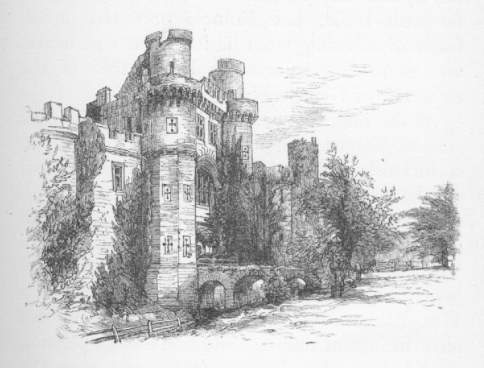
HURSTMONCEAUX CASTLE.
was supposed to have died in India and
insolvent, he had really died very rich, and that if his
relations chose to make inquiries, they might inherit his fortune!
At the time I declared that the story could not be true, as we
never had any relation who had anything to do with India, but
Francis persisted steadfastly in affirming what he had seen and
heard, and some time afterwards I was told of the existence of
George Hare.
At the time we were at Bath, Aunt
Caroline was no longer living there; she had become so furiously
jealous of Mrs. Marcus Hare, that she had to be kept under
restraint, and though not actually mad, she lived alone with an
attendant in a cottage at Burnet near Corsham. There she died
some years after, very unhappy, poor thing, to the last. Her
companion was a Mrs. Barbara, with whom Aunt Caroline was most
furious at times. She had a large pension after her death. It
used to be said that the reason why Mrs. Barbara had only one arm
and part of another was that Aunt Caroline had eaten the rest.11
It was when we were staying with Aunt
Marianne in 1839 that I first saw my real mother "On est me'
re, ou on ne l'est pas," says the Madame Cardinal of Ludovic
Halévy. In my case "on ne l'était pas." I watched Mrs.
Hare's arrival, and, through the banisters of the staircase, -
saw her cross the hall, and was on the tiptoe of expectation; but
she displayed no interest about seeing me, and did not ask for me
at all till late in the evening, when all enthusiasm had died
away. "I hope the Wolf answered your expectations, or still
better surpassed them," wrote my father to his wife from
West Woodhay. He was in the habit of calling all his children by
the names of beasts. "Bring some cold-cream for the Tigress"
(my sister), he wrote at the same time, and "the Owl (Eleanor
Paul) and the Beast (William) are going to dine out."
Francis he generally called "Ping," and his wife "Mrs.
Pook."
Aunt Marianne, wishing to flatter Uncle
Julius's love of learning, proudly announced to him that she had
given me a book - a present I was perfectly enchanted with - when,
to my intense dismay, he insisted upon exchanging it for a
skipping-rope! which I could never be persuaded to use.
In the autumn of 1839 my father again
returned with his family to Pisa, to the bitter grief of old Mrs.
Louisa Shipley, who refused altogether to take leave of Mrs. Hare,
though she afterwards wrote (Oct. 16), "I hope Anne has
forgiven my rudeness her last day. I was too sorry to part with
you to admit any third person. She was already rapidly failing,
but she still wrote, "Your letters always give me pleasure,
when I can read them, but to be sure they take a long time in
deciphering." In the course of the following winter Mrs.
Louisa Shipley died, without seeing her favourite nephew again.
It was found then that she had never forgiven the last emigration
to Italy against her wishes. Except a legacy to my Uncle Marcus,
she left all she possessed to her next neighbour and cousin, Mrs.
Townshend (daughter of Lady Milner - half-sister of Mrs. Shipley)
- a will which caused terrible heartburnings amongst her more
immediate relations, especially as many precious relics of Lady
Jones and of Mrs. Hare Naylor were included in the property thus
bequeathed. At the same time the estate of Gresford in Flintshire,
which Bishop Shipley had left to each of his daughters in turn,
now, on the death of the last of them, descended to my father, as
the eldest son of the eldest daughter who had left children.
Victoire remembered the arrival of the
letter, sealed with black, which announced the death of Mrs.
Shipley, whilst the Hare family were at Florence. Félix was with
his master when he opened the letter, and came in afterwards to
his wife, exclaiming, "Oh mon pauvre M. Hare a eu bien de
malheur." Francis Hare had thrown up his hands and said,
"Félix, nous sommes perdus." All that day he would not
dress, and he walked up and down the room in his dressing-gown,
quite pale. He never was the same person again. Up to that time
he had always been "si gai" - he was always smiling. He
was "si recherché." "Avec les grands il était si
franc, si charmant, mais avec les personnes de basse condition il
était encore plus aimable que avec les grands personnages. Oh!
comme il était aimé . . . Jusque là il était invité partout,
et il donnait toujours à diner et ses fêtes, et son
introduction était comme un passeport partout. Mais depuis là
il ne faisait pas le même - et c'était juste il faudrait penser
à ses enfants."12
But I am digressing from my own story,
and must return to the intensely happy time of escaping from
Rockend and going to Stoke. It was during this journey that I
first saw any ruin of importance beyond Hurstmonceaux and
Pevensey. This was Glastonbury Abbey, and it made a great
impression upon me. I also saw the famous Christmas-blooming
thorn, which is said to have grown from St. Joseph of Arimathea's
staff, in the abbot's garden, bright with hepaticas. I remember
at Stoke this year having for the first time a sense of how much
the pleasantness of religious things depends upon the person who
expresses them. During the winter my mother saw much of the
voluminous author Mr. Charles Tayler, who was then acting as
curate at Hodnet. He was very frank and sincere, and his "religious
talking" I didn't mind at all; whereas when the Maurices
"talked," I thought it quite loathsome. In the
following summer I used often to listen to conversations between
Mr. Manning (afterwards Archdeacon, then Cardinal) and my mother,
as he then first fell into the habit of coming constantly to
Hurstmonceaux and being very intimate with my mother and uncle.
He was very lovable and one of the most perfectly gentle gentle-men
I have ever known ; my real mother used to call him "l'harmonie
de la poésie religieuse." My mother was very unhappy when
he became a Roman Catholic in 1851.
How many happy recollections I have of
hot summer days in the unbroken tranquillity of these summers at
Lime. My mother was then the object of my uncle's exclusive
devotion. He consulted her on every subject, and he thought every
day a blank in which they had no meeting. We constantly drove up
to the Rectory in the afternoon, when he had always some new
plant to show her and to talk about. I well remember his
enchantment over some of the new flowers which were being "invented"
then - especially Salpiglossis (so exceedingly admired at
first, but now forgotten), Salvia patens and Fuchsia
fulgens, of which we brought back from Wood's Nursery a
little plant, which was looked upon as a perfect marvel of nature.
Often when awake in the night now, I
recall, out of the multiplicity of pretty, even valuable things,
with which my house of Holmhurst is filled, how few of them
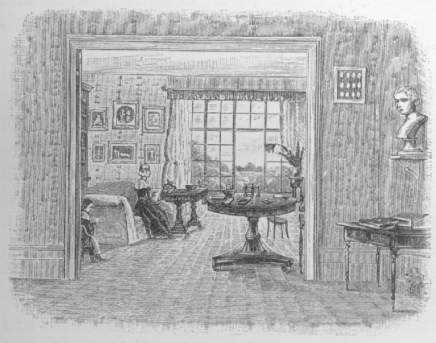
belonged to our dear simple home in these early days. The small
double hall had nothing in it, I think, except a few chairs, and
some cloaks banging on pegs against the wall, and the simple
furniture of the double drawing-room consisted chiefly of the
gifts made to my mother by her family when she went to Alton. One
wall - the longest - was, however, occupied by a great bookcase,
filled with handsomely bound books, chiefly divinity, many of
them German. On the other walls hung a very few valuable
engravings, mostly from Raffaelle, and all framed according to
Uncle Julius's fancy, which would have driven print-collectors
frantic, for he cut off all margins, even of proofs before
letters. The only point of colour in the room, not given by
flowers, came from a large panel picture presented by Landor-a
Madonna and Child by Raffaellino da Colle, in a fine old Italian
frame. The few china ornaments on the chimney-piece beneath were
many of them broken, but they were infinitely precious to us. In
the dining-room were only a few prints of Reginald Heber, my
Uncle Norwich, my grandfather Leycester, and others. Simpler
still were the bedrooms, where the curtains of the windows and
beds were of white dimity. In my mother's room, however, were
some beautiful sketches of the older family by Flaxman. The
"pantry," which was Lea's especial sitting-room, where
the walls were covered with pictures and the mantel-piece laden
with china, had more the look of rooms of the present time. I
believe, however, that the almost spiritualised aspect of my
mother's rooms at Lime were as characteristic of her at this time,
as the more mundane rooms of my after home of Holmhurst are
characteristic of myself!
My mother and I breakfasted every
morning at eight (as far as I can remember, I never had
any meal in the so-called nursery) in the dining-room, which, as
well as the drawing-room, had wide glass doors always open to the
little terrace of the garden, from which the smell of new-mown
grass or dewy pinks and syringa was wafted into the room. If it
was very hot too, our breakfast took place on the terrace,
in the deep shadow of the house, outside the
THE DRAWING-ROOM AT
LIME,
little drawing-room window. After
breakfast I began my lessons, which, though my mother and uncle
always considered me a dunce, I now think to have been rather
advanced for a child of five years old, as besides English
reading, writing and spelling, history, arithmetic and geography,
I had to do German reading and writing, and a little Latin.
Botany and drawing I was also taught, but they were an intense
delight. Through plans, maps, and raised models, I was made
perfectly familiar with the topography of Jerusalem and the
architecture of the Temple, though utterly ignorant of the
topography of Rome or London and of the architecture of St. Peter's
or St. Paul's. But indeed I never recollect the moment of (indoor)
childhood in which I was not undergoing education of some kind,
and generally of an unwelcome kind. There was often a good deal
of screaming and crying over the writing and arithmetic, and I
never got on satisfactorily with the former till my Aunt Kitty (Mrs.
Stanley) or my grandmother (Mrs. Leycester) took it in hand,
sitting over me 'with a ruler, and by a succession of hearty
bangs on the knuckles, forced my fingers to go the right way. At
twelve o'clock I went out with my mother, sometimes to Lime Cross
(village) and to the fields behind it, where I used to make
nosegays of "robin's-eye and ground-ivy," - my love of
flowers being always encouraged by mother, whose interest in
Nature had a freshness like tile poetry of Burns, observing
everything as it came out -
"The rustling
corn, the freited thorn,
And every happy
creature."
Generally, however, we went to the girls'
school at "Flowers Green," about half a mile off on the
way to the church, where Mrs. Piper was the mistress, a dear old
woman who recollected the destruction of the castle, and had
known all my uncles in their childhood at Hurstmonceaux Place. At
the school was a courtyard, overhung with laburnums, where I
remember my mother in her lilac muslin dress sitting and teaching
the children under a bower of golden rain.
I wonder what would be thought of dear
old Mrs. Piper, in these days of board-schools and examinations
for certificates. "Now, Mr. Simpikins," she said one
day to Mr. Simpkinson the curate, whose name she never could
master - " Now Mr. Simpikins, do tell me, was that Joseph
who they sold into Egypt the same as that Joseph who was married
to the Virgin Mary?" – "Oh no, they were hundreds
of years apart." – "Well, they both went down into
Egypt anyway." Yet Mrs. Piper was admirably suited to her
position, and the girls of her tuition were taught to sew and
keep house and "mind their manners and morals," and
there were many good women at Hurstmonceaux till her pupils
became extinct. The universal respect with which the devil is
still spoken of at Hurstmonceaux is probably due to Mrs. Piper's
peculiar teaching.
But, to return to our own life, at one
we had dinner-almost always roast-mutton and rice-pudding-and
then I read aloud-Josephus at a very early age, and then
Froissart's Chronicles. At three we went out in the carriage to
distant cottages, often ending at the Rectory. At five I was
allowed to "amuse myself," which generally meant
nursing the cat for half-an-hour and "hearing it its lessons."
All the day I had been with my mother, and now generally went to
my dear nurse Lea for half-an-hour, when I had tea in the cool
"servants' hall" (where, however, the servants never
sat-preferring the kitchen), after which I returned to find Uncle
Julius arrived, who stayed till my bedtime.
As Uncle Julius was never captivating to
children, it is a great pity that he was turned into an
additional bugbear, by being always sent for to whip me when I
was naughty! These executions generally took place with a riding-whip
- and looking back dispassionately through the distance of years,
I am conscious that, for a delicate child, they were a great deal
too severe. I always screamed dreadfully in the anticipation of
them, but bore them without a sound or a tear. I remember one
very hot summer's day, when I had been very naughty over my
lessons, Froissart's Chronicles having been particularly
uninteresting, and having produced the very effect which
Ahasuerus desired to obtain from the reading of the book of the
records of the chronicles, that Uncle Julius was summoned. He
arrived, and I was sent upstairs to "prepare." Then, as
I knew I was going to be whipped anyway, I thought I might as
well do something horrible to be whipped for, and, as soon
as I reached the head of the stairs, gave three of the most awful,
appalling and eldrich shrieks that ever were heard in
Hurstmonceaux. Then I fled for my life. Through the nursery was a
small bedroom, in which Lea slept, and here I knew that a large
black travelling "imperial" was kept under the bed.
Under the bed I crawled, and wedged myself into the narrow space
behind the imperial, between it and the wall. I was only just in
time. In an instant all the household - mother, uncle, servants-were
in motion, and a search was on foot all over the house. I turn
cold still when I remember the agony of fright with which I heard
Uncle Julius enter the nursery, and then, with which, through a
chink; I could see his large feet moving about the very room in
which I was. He looked under the bed, but he saw only a
large black box. I held my breath, motionless, and he turned away.
Others looked under the bed too; but my concealment was effectual.
I lay under the bed for an hour –
stifling - agonised. Then all sounds died away, and I knew that
the search in the house was over, and that they were searching
the garden. At last my curiosity would no longer allow me to be
still, and I crept from under the bed and crawled to the window
of my mother's bedroom, whence I could overlook the garden
without being seen. Every dark shrub, every odd corner was being
ransacked. The whole household and the gardeners were engaged in
the pursuit. At last I could see by their actions - for I could
not hear words - that a dreadful idea had presented itself. In my
paroxysms I had rushed down the steep bank, and tumbled or thrown
myself into the pond! I saw my mother look very wretched and
Uncle Julius try to calm her. At last they sent for people to
drag the pond. Then I could bear my dear mother's expression no
longer, and, from my high window, I gave a little hoot. Instantly
all was changed; Lea rushed upstairs to embrace me; there was
great talking and excitement, and while it was going on, Uncle
Julius was called away, and every one forgot that I had not been
whipped! That, however, was the only time I ever escaped.
In the most literal sense, and in every
other, I was "brought up at the point of the rod." My
dearest mother was so afraid of over-indulgence that she always
went into the opposite extreme: and her constant habits of self-examination
made her detect the slightest act of especial kindness into which
she had been betrayed, and instantly determine not to repeat it.
Nevertheless, I loved her most passionately, and many tearful
fits, for which I was severely punished as fits of naughtiness,
were really caused by anguish at the thought that I had
displeased her or been a trouble to her. From never daring to
express my wishes in
words, which she would have thought it a
duty to meet by an immediate refusal, I early became a coward as
to concealing what I really desired. I remember once, in my
longing for childish companionship, so intensely desiring that
the little Coshams - a family of children who lived in the parish
- might come to play with me, that I entreated that they might
come to have tea in the summer-house on my Hurstmonceaux birthday
(the day of my adoption), and that the mere request was not only
refused, but so punished that I never dared to express a wish to
play with any child again. At the same time I was expected to
play with little Marcus, then an indulged disagreeable child whom
I could not endure, and because I was not fond of him, was
thought intensely selfish and self-seeking.
As an example of the severe discipline
which was maintained with regard to me, I remember that one day
when we went to visit the curate, a lady (Miss Garden) very
innocently gave me a lollypop, which I ate. This crime was
discovered when we came home by the smell of peppermint, and a
large dose of rhubarb and soda was at once administered with a
forcing-spoon, though I was in robust health at the time, to
teach me to avoid such carnal indulgences as lollypops for the
future. For two years, also, I was obliged to swallow a dose of
rhubarb every morning and every evening because-according to old-fashioned
ideas - it was supposed to "strengthen the stomach!" I
am sure it did me a great deal of harm, and had much to do with
accounting for my after sickliness. Sometimes I believe the
medicine itself induced fits of fretfulness; but if I cried more
than usual, it was supposed to be from want of additional
medicine, and the next morning senna-tea was added to the rhubarb.
I remember the misery of sitting on the backstairs in the morning
and having it in a teacup, with milk and sugar.
At a very early age I was made to go to
church - once, which very soon grew into twice, on a Sunday.
Uncle Julius's endless sermons were my detestation. I remember
some one speaking of him to an old man in the parish, and being
surprised by the statement that he was "not a good winter
parson," which was explained to mean that he kept the people
so long with his sermons, that they could not get home before
dark.
With the utmost real kindness of heart,
Uncle Julius had often the sharpest and most insulting manner I
have ever known in speaking to those who disagreed with him. I
remember an instance of this when Mr. Simpkinson had lately come
to Hurstmonceaux as my uncle's curate. His sister, then a very
handsome young lady, had come down from. London to visit him, and
my mother took her to church in the carriage. That Sunday
happened to be Michaelmas Day. As we were driving slowly away
from church through the crowd of those who had formed the.
congregation, Uncle Julius holding the reins, something was said
about the day. Without a suspicion of giving offence, Miss
Simpkinson, who was sitting behind with me, said, in a careless
way, "As for me, my chief association with Michaelmas Day is
a roast goose." Then Uncle Julius turned round, and, in a
voice of thunder, audible to every one on the road,
exclaimed, "Ignorant and presumptuous young woman!" He
had never seen her till that day. As she said to me years after,
when she was a wife and mother, "That the Archdeacon should
call me ignorant and presumptuous was trying, still I could bear
that. very well; but that he should dare to call me a young
woman was not to be endured." However, her only
alternative was to bear the affront and be driven two miles home,
or to insist upon getting out of the carriage and walking home
through the mud, and she chose the former course, and afterwards
my uncle, when he knew her good qualities, both admired and liked
her.
It must have been about this time that
Uncle Julius delivered his sermons on "the Mission of the
Comforter" at Cambridge, and many of his friends used to
amuse my mother by describing them. The church was crowded, but
the congregation was prepared for sermons of ordinary length. The
Halls then "went in" at three, and when that hour came,
and there was no sign of a conclusion, great was the shuffling of
feet. This was especially the case during the sermon on "The
Church the Light of the World," but Uncle Julius did not
care a bit, and went on till 3.20 quite composedly.
At this time it used to be said that
Uncle Julius had five popes - Wordsworth, Niebuhr, Bunsen,
Frederick Maurice, and Manning.13 They were very different certainly, but he
was equally up in arms if any of these were attacked.
I was not six years old before my mother
- under the influence of the Maurices-began to follow out a code
of penance with regard to me which was worthy of the ascetics of
the desert. Hitherto I had never been allowed anything but roast-mutton
and rice-pudding for dinner Now all was changed. The most
delicious puddings were talked of - dilated on - until I
became, not greedy, but exceedingly curious about them. At length
"le grand moment" arrived. They were put on the table
before me, and then, just as I was going to eat some of them,
they were snatched away, and I was told to get up and carry them
off to some poor person in the village. I remember that, though I
did not really in the least care about the dainties, I cared
excessively about Lea's wrath at the fate of her nice puddings,
of which, after all, I was most innocent. We used at this time to
read a great deal about the saints, and the names of Polycarp,
Athanasius, &c., became as familiar to me as those of our own
household. Perhaps my mother, through Esther Maurice's influence,
was just a little High Church at this time, and always fasted to
a certain extent on Wednesdays and Fridays, on which days I was
never allowed to eat butter or to have any pudding. Priscilla
Maurice also even persuaded Uncle Julius to have a service in the
schoolroom at (the principal village) Gardner Street on saints'
days, which was attended by one old woman and ourselves. My
mother, who always appropriated to charities all money she
received for the sale of my Uncle Augustus's sermons, also now
spent part of it in the so-called "restoration" of
Hurstmonceaux Church, when all the old pews were swept away and
very hideous varnished benches put in their place. Uncle Julius,
as soon as he became Archdeacon, used to preach a perfect crusade
against pews, and often went, saw and hammer in hand, to begin
the work in the village churches with his own hands.
Our own life through these years
continued to be of the most primitive and simple kind. A new book
or a new flower was its greatest event-an event to be chronicled
and which only came once or twice a year. Many little luxuries,
most common now, were not invented then, steel-pens and wax-matches
for instance, and, amongst a thousand other unobserved
deficiencies, there were no night-lights, except of a most
rudimentary kind. No one ever thought of having baths in their
rooms then, even in the most comfortable houses: a footpan or a
"bidet" was the utmost luxury attempted.
It was in the spring of 1839 that I had
my first associations with death. Often, in my earliest childish
days, had I seen the sweet and charming Lady Parry, who, as Bella
Stanley, had been one of the dearest friends of my mother's youth.
While our dear cousins Charlotte and Emma Leycester were at Lime,
the news came of her death, and I remember how they and my mother
sate over the fire crying, and of gradually understanding the
cause, and of tears being renewed for several mornings afterwards,
when details were received from Sir Edward Parry and old Lady
Stanley.
From MY MOTHER'S
JOURNAL.
"Lime, June 18, 1839.-During
a week spent in London, Augustus was part of every day with
his brothers and sister. Their first meeting was at Sheen.
Augustus was much excited before they came, and when he saw
his brothers, threw himself on my neck and kissed me
passionately. They were soon intimate, and he was very much
delighted at playing with them, and was not made fretful by
it. There seemed to be a strong feeling of affection awakened
towards them, unlike anything he has shown to other children.
I have begun to teach Augustus to draw, but it is wearisome
work from his inattention. His delight in flowers and
knowledge of their names is greater than ever, and it is
equally necessary to control his gratification in this as in
other pleasures. The usual punishment for his impatience over
dressing is to have no garden flowers,
"In all the books of education
I do not find what I believe is the useful view taken of the
actual labour of learning to read-that of forcing the child's
attention to a thing irksome to it and without interest. The
task is commonly spoken of as a means to an end, necessary
because the information in books cannot otherwise be obtained,
and it is to be put off till the child's interest in the
information is excited and so made a pleasure to him. Now it
seems to me to be an excellent discipline whereby daily some
self-denial and command may be acquired in overcoming the
repugnance to doing from duty that which has in itself no
attraction. In the first struggle to fix the attention and
learn that which is without interest, but which must be
done, a habit is gained of great importance. And in this
way nothing is better suited to the purpose than the lesson
of reading, even though little progress may be made for a
long time.
"I find in giving any order to
a child, it is always better not to look to see if he
obeys, but to take it for granted it will be done. If one
appears to doubt the obedience, there is occasion given for
the child to hesitate, 'Shall I do it or no?' If you seem not
to question the possibility of non-compliance, he feels a
trust committed to him to keep and fulfils it. It is best
never to repeat a command, never to answer the oft-asked
question 'why?'
"Augustus would, I believe,
always do a thing if reasoned with about it, but the
necessity of obedience without reasoning is specially
necessary in such a disposition as his. The will is the thing
that needs being brought into subjection.
"The withholding a pleasure is
a safe punishment for naughtiness, more safe, I think, than
giving a reward for goodness. 'If you are naughty I must
punish you,' is often a necessary threat: but it is not good
to hold out a bribe for goodness – 'If you are good I
will give you such a thing.'"
In the autumn of 1839 we went for the
first time to Norwich and spent Christmas there, which was most
enchanting to me. The old buildings of Norwich gave me, even at
five years old, the intense and passionate pleasure with which I
have ever since regarded them. No others are the same. No others
come back to me constantly in dreams in the same way.
How I revelled in the old Palace of that
time, with its immensely long rambling passages and carved
furniture; in the great dining-room with the pictures of the
Christian Virtues, and the broad damp matted staircase with heavy
banisters which led through it towards the cathedral, which it
entered after passing the mysterious chapel-door with its wrought-iron
grille, and a quaint little court, in which a raven and a seagull,
two of the many pets of my uncle the Bishop, usually disported
themselves! Then, in the garden were the old gateway and the
beautiful ruin of the first bishop's palace, and, beyond the ruin,
broad walks in the kitchen garden, ending in a summer-house, and
a grand old mulberry-tree in a corner. Outside the grounds of the
Palace, it was a joy to go with Lea by the old gate-house over
the Ferry to Mousehold Heath, where delightful pebbles were to be
picked up, and to the Cow Tower by the river Wensum: and
sometimes Aunt Kitty took me in the carriage to Bramerton, where
my kind old uncle taught me the names
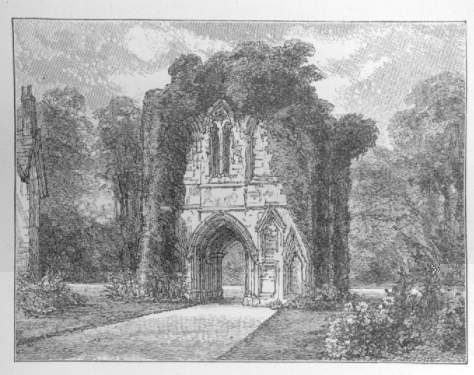
RUIN IN THE PALACE
GARDEN, NORWICH.
of all the different fossils, which I
have never forgotten to this day.
My Aunt Kitty was deeply interesting,
but also very awful to me. I could always tell when she thought I
was silly by her looks, just as if she said it in words. I was
dreadfully afraid of her, but irresistibly attracted to her. Like
my mother, I never differed from her opinion or rebelled against
her word. She was pleased with my attempts to draw, and tried to
teach me, drawing before me from very simple objects, and then
leaving me her outlines to copy, before attempting to imitate the
reality.
My cousins, Mary and Kate, had two rooms
filled with pictures and other treasures, which were approached
by a very steep staircase of their own. I soon began to be
especially devoted to Kate, but I thought it perfect rapture to
pay both of them visits in their rooms and "make waxworks"
with the little bits of coloured wax off the taper-candles which
they collected for me. Besides, in her room Kate kept a wonderful
little live owl. My cousin Arthur Stanley was also very
attractive to me. He was quite young at this time - had not taken
his Oxford degree, I think - and had a very charming and
expressive countenance. If it had not been for this, and his
winning smile, I suppose that in manners (certainly in dress) he
would have been thought very wanting. He scarcely ever spoke to
strangers, and coloured violently when spoken to. His father he
was most piteously afraid of. I do not think he was quite
comfortable and at home with
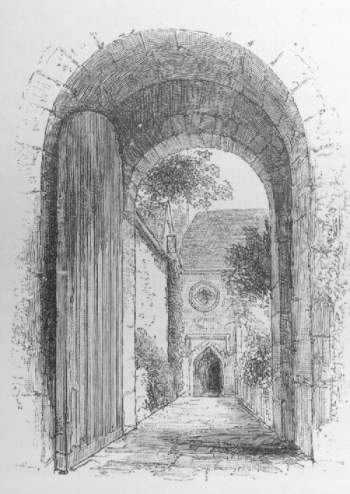
THE CHAPEL DOOR,
NORWICH.
any one except his two sisters. But he
noticed me a good deal as a child, and told me stories out of the
History of England, which I liked immensely. Hugh Pearson,
afterwards my dear friend, recollected how, on overhearing him
and Arthur in the chapel talking about the inscription on the
tomb of Bishop Sparrow, who wrote the "Rationale," I
exclaimed, "Oh cousin Arthur, do tell me about Bishop
Sparrow and the Russian lady." I used to play with the
children of Canon Wodehouse, who, with his charming wife, Lady
Jane, lived close to the Palace. With their two youngest
daughters, Emily and Alice, I was great friends, and long kept up
a childish correspondence with them, on the tiniest possible
sheets of paper. Emily had bright red hair, but it toned down,
and after she grew up she was very much admired as Mrs. Legh of
Lyme. On the way to the Ferry lived Professor Sedgwick, who was
always very kind to me. He once took me with him to a shop and
presented me with a great illustrated "Robinson Crusoe."
From MY MOTHER'S JOURNAL.
"Stoke Feb.
12, 1840. - Augustus's chief delight of late has
been stories out of the History of England, and the 'Chapter
of Kings' is a continual source of interest and pleasure. His
memory in these things is very strong and his quick
apprehension of times and circumstances. I should say the
historical organ was very decided in him, and he seems to
have it to the exclusion of the simple childlike view of
everything common to his age. In reading the account of the
flood yesterday he asked, 'What books did Noah take into the
Ark? he must have taken a Bible.' – 'No - the people
lived after his time.' – 'Then he must have had one of
Adam and Eve and Cain and Abel.' – 'How dreadful it must
have been for Noah to see all the dead bodies when he came
out of the Ark.'
"'How much ground there will be
when we all die!' – 'Why so ?' – 'Because we shall
all turn to dust.'
"There is a strong predominance
of the intellectual over the moral feeling in him, I fear,
and it must be my endeavour always to draw out and encourage
the love of what is good and noble in character and action.
His eyes, however, always fill with tears on hearing any
trait of this kind, and he readily melts at any act of self-denial
or affection, so that his talking little of these things must
not perhaps be dwelt upon as a sure sign of not estimating
them."
"August 5. - There is
just the same greediness in Augustus now about books that
there used to be about flowers, and I have to restrain the
taste for novelty and excitement. Reading of a little girl
who was fond of her Bible, he said, 'I should not have been
so. I like my fat Yellow Book much better, but I like the
Bible far better than the Prayer-Book: I do not like that at
all.'"
In this year of 1840, Uncle Julius
accepted the Archdeaconry of Lewes, which wrought a change in our
quiet life from the great number of clergy who were now constant
guests at the Rectory and the greater frequency of clerical
subjects of discussion at Lime. Once a year also, we went
regularly to Hastings for a night before my uncle gave his charge
to the clergy, driving back late afterwards through the hot lanes.
I always liked this expedition and scrambling about with Lea on
the mile of open common which then intervened between St.
Leonards and Hastings: but it was dreadfully tantalising, when I
was longing to go to the sea on the second day, that I was
expected to remain for hours in the hot St. Clement's Church,
while the sermon and charge were going on, and that the charge,
of which I understood nothing except that I hated it, sometimes
lasted three hours!
Mr. John Nassau Simpkinson14 was now curate to my uncle, and lived in
"the Curatage" at Gardner Street with his sister Louisa
and her friend Miss Dixon, whom we saw constantly. They persuaded
my mother to have weekly "parish tea-parties," at which
all the so-called "ladies of the parish" came to spend
the evening, drink tea, and work for the poor, while one of them
read aloud from a Missionary Report. I think it was also at the
suggestion of Miss Simpkinson that my mother adopted a
little Hindoo girl (whom of course she never saw), putting her to
school, paying for her, and otherwise providing for her.
A little excitement of our quiet summer
was the marriage, in our old church, of my half-uncle Gustavus
Hare, then a handsome young officer, to a pretty penniless Miss
Annie Wright. It was a most imprudent marriage, and would
probably have" been broken off at the last moment, if my
mother had not been melted by their distress into settling
something (£1200 I think) upon them. I remember that it was
thought a good omen that a firefly (one had never been seen at
Hurstmonceaux before) perched, with its little lamp, upon the
bride on the evening before the marriage. Mrs. Gustavus Hare
proved an admirable wife and a good mother to her army of
children. They lived for some time in Devonshire, and then in
Ireland: whence, in 1868, they went to Australia, and afterwards
passed entirely out of the family horizon, though I believe many
of the children are still living.
In the autumn, a great enjoyment was
driving in our own little carriage, with "Dull," the
old horse (mother, Uncle Julius, Lea, and I), to spend a few days
with the Penrhyns at Sheen, sleeping at Godstone and passing
through Ashdown Forest. In those days, however, by starting early
and posting, the journey from Lime to London could be
accomplished in one day, but our annual journey from London to
Stoke (in - Shropshire) occupied three days. My mother and I used
to play at "gates and stiles," counting them, through
the whole journey. Unluckily the swinging motion of our great
travelling chariot always made me so sick that I had a horror of
these journeys; but we -had pleasant hours in the evenings at the
old posting-inns, with their civil old-fashioned servants and
comfortable sitting-rooms with the heavy mahogany furniture which
one so seldom sees now, and sometimes we arrived early enough for
a walk, which had all the interest of an expedition into an
unknown territory. Well do I remember certain fields near the
comfortable old inn of Chapel House, and the daisies which Lea
and I used to pick there. After my Aunt Kitty gave me my first
taste for antiquities when showing me, at Stoke, the picture of
Old Time in the frontispiece of Grose's "Antiquities,"
these journeys had a fresh interest, and greatly did I delight in
the glimpse of Brambletye House, as we passed through Ashdown
Forest, and the little tower of Stafford Castle at the top of its
wooded hill. Once also we slept at Peterborough and saw its
cathedral, and on the way to Norwich it was always an ecstasy to
see and draw Thetford Abbey.
On the third day from London, when
evening was drawing to a close, we began to reach familiar scenes-the
inn of "the Logger-heads," with the sign of the two
heads and the motto -
"We three
Loggerheads be."
Market-Drayton, paved with round pebbles,
over which the carriage jolted violently, the few lamps being
lighted against the black and white houses at the dark street
corners : Little Drayton shabbier still, with the gaudy sign of
the Lord Hill public-house, then of "The Conquering Hero,"
with the same intention:
Stoke Heath, at that time a wild pine-wood
carpeted with heather: some narrow lanes between high hedgerows:
a white gate in a hollow with river-watered meadows: a drive
between steep mossy banks with beech-trees, and a glimpse of an
old church and tufted islands rising from the river in the flat
meadows beyond: then the long windows and projecting porch of a
white house with two gables. As we drove up, we could see through
the windows two figures rising hastily from their red armchairs
on either side the fire - an ancient Lady in a rather smart cap,
and an old gentleman with snow-white hair and the dearest face in
the world - Grannie and Grandpapa.
The happiest days of my childish years
were all condensed in the five months which we annually spent at
Stoke (away from Uncle Julius, Aunt Georgiana, and the Maurices).
Grandpapa did not take much notice of my existence, but when he
did it was always in kindness, though I believe he had rather
resented my adoption. Grannie (who was only my mother's
stepmother but married to Grandpapa when she was quite a child)
was tremendously severe, but also very good to me: she never
"kept me at a distance," so, though she often punished
me, I was never afraid of her-" Better a little chiding than
a great deal of heart-break."15
The quaint old house was also suited to
my imaginative disposition, and I thought the winding passage in
the older part quite charming, and never observed that my bedroom
had no carpet, and that the fender, which was the whole height of
the mantel-piece, shut in all the warmth of the fire. A dark back-staircase
with a swing door and a heavy bolt, which I thought most romantic,
led hence to the offices.
In memory I can still see dear Grannie
coming downstairs in the morning, with her little fat red and
white spaniel Rose (it had belonged to her sister Rosamund)
barking before hen She used to make Grandpapa read prayers in
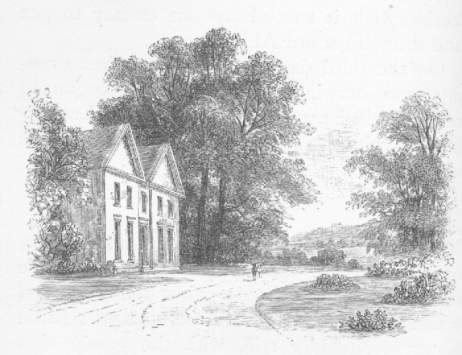
STOKE RECTORY - THE
APPROACH.
the study, a little long room close to
the offices, which had a white bookcase along one side full of
old books in white paper covers, and on the other a number of
quaint old pictures of Switzerland. Square green baize cushions
were put down in front of each of the "quality" for
them to kneel upon, and were taken away as soon as the
performance was oven I had my breakfast in the little room of Mrs.
Cowbourne, my Grannie's dear old maid, which was through the
kitchen, and deliciously warm and comfortable. I always. remember
the three glazed green flower-pots which stood in the window of
that room, and which held respectively a double geranium, a
trailing hop, and a very peculiar kind of small fuchsia, which
one never sees now, with very small flowers. Sometimes I went in
to see the men and maids have their breakfast at the long table
in the servants' hall: the maids had only great bowls of bread
and milk; tea and bread and butter were never thought of below
the housekeeper's room.
I did my lessons in my mother's room
upstairs, which, as she always brought with her a picture of the
four Hare brothers, and certain books from home in familiar
covers, suggested a salutary reminiscence of Uncle Julius.
Spelling and geography were always trials, the latter because the
geography book was so dreadfully uninteresting: it told us how
many inhabitants there were in the States of Lucca and Modena. I
never had any playthings at Stoke: my amusement was to draw on
all the bits of paper I could get hold of; but I only drew two
subjects, over and over again - the Day of Judgment, and Adam and
Eve being turned out of Paradise: these were of inexhaustible
interest. Sometimes I was allowed to have the little volumes of
"Voyages and Travels" to look at (I have them now),
with the enchanting woodcuts of the adventures of Columbus,
Cortes, and Pizarro: and there were certain little books of
Natural History, almost equally delightful, which lived on the
same shelf of the great bookcase in the drawing-room, and were
got down by a little flight of red steps.
I scarcely ever remember Grannie as
going out, except sometimes to church. She was generally in one
extreme or other of inflammation or cold; but it never went
beyond a certain point, and when she was thought to be most ill,
she suddenly got well. Grand-papa used to walk with my mother in
the high "rope-walk" at the top of the field, and I
used to frisk away from them and find amusement in the names
which my mother and her companions had cut on the beech-trees in
their youth: in the queer dark corners of rock-work and shrubbery:
in the deliciously high sweet box hedge at the bottom of the
kitchen-garden; and most of all in the pretty little river
Clarence, which flowed to join the Terne under a wooden bridge in
a further garden which also belonged to the Rectory. But, if
Grandpapa was not with us, we used to go to the islands in the
Terne, reached by straight paths along the edge of wide ditches
in the meadows. Two wooden bridges in succession led to the
principal island, which was covered with fine old willow-trees,
beneath which perfect masses of snowdrops came up in spring. At
the end was a little bathing-house, painted white inside, and
surrounded with cupboards, where I used to conceal various
treasures, and find them again the following year. I also buried
a bird near the bathing-house, and used to dig it up every year
to see how the skeleton was getting on. My mother had always
delightful stories to tell of this island in her own childhood,
and of her having twice tumbled into the. river: I was never
tired of hearing them.
Another great enjoyment was to find
skeleton-leaves, chiefly lime-leaves. There was a damp-meadow
which we called "the skeleton-ground" from the number
we found there. I have never seen any since my childhood, but I
learnt a way then of filling up the fibres with gum, after which
one could paint upon them. Our man-servant, John Gidman, used to
make beautiful arrows for me with the reeds which grew in the
marshy meadows or by "Jackson's Pool" (a delightful
place near which snowdrops grew wild), and I used to "go out
shooting" with a bow. Also, in one of the lumber-rooms I
found an old spinning-wheel, upon which I used to spin all the
wool I could pick off the hedges: and there was a little churn in
which it was enchanting to make butter, but this was only allowed
as a great treat.
I always found the Shropshire lanes
infinitely more amusing than those at Hurstmonceaux. Beyond the
dirty village where we used to go to visit "Molly Latham and
Hannah Berry" was a picturesque old water-mill, of which
Grandpapa had many sketches. Then out of the hedge came two
streamlets through pipes, which to me had all the beauty of
waterfalls. Close to the Terne stood a beautiful old black and
white farmhouse called Petsey. The Hodnet Lane (delightfully
productive of wool), which ran in front of it, led also to Cotton,
a farmhouse on a hill, whither my mother often went to visit
"Anne Beacoll," and which was infinitely amusing to me.
At the corner of the farmyard was a gigantic stone, of which I
wonder to this day how it got there, which
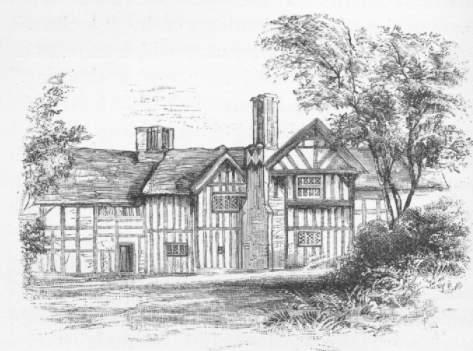
PETSEY.
Grandpapa always told me to put in my
pocket. But I liked best of all to beguile my mother in another
direction through a muddy lane, in which we were half swamped, to
Helshore, for there, on a promontory above the little river,
where she remembered an old house in her childhood, the crocuses
and polyanthuses of the deserted garden were still to be found in
spring under the moss-grown apple-trees.
My grandparents and my mother dined at
six. The dining-room had two pillars, and I was allowed to remain
in the room and play behind them noiselessly: generally acting
knights and heroes out of my ballad-books. At Hurstmonceaux I
should have been punished at once if I ever made a noise, but at
Stoke, if I was betrayed into doing so, which was not very often,
Grannie would say, "Never mind the child, Maria, it is only
innocent play." I can hear her tone now. Sometimes when
"Uncle Ned" (the Bishop of Norwich) came, he used to
tell me the story of Mrs. Yellowly, cutting an orange like an old
lady's face, and "how Mrs. Yellowly went to sea," with
results quite shocking-which may be better imagined than
described. In the dining-room were two framed prints of the death
of Lord Chatham (from Copley's picture) and of Lord Nelson, in
which the multitude of figures always left something to be
discovered. At the end of the room was a "horse" - a
sort of stilted chair on high springs, for exercise on wet days.
In the evenings my mother
used to read aloud to her old parents. Miss Strickland's "Queens
of England" came out then, and were all read aloud in turn.
If I found the book beyond my comprehension, I was allowed, till
about six years old, to amuse myself with some ivory fish, which
I believe were intended for card-markers. Occasionally Margaret,
the housemaid, read aloud, and very well too. She also sang
beautifully, having been thoroughly well trained by Mrs.
Leycester, and I never hear the Collect "Lord of all power
and might" without thinking of her. Grannie was herself
celebrated for reading aloud, having been taught by Mrs. Siddons,
with whom her family were very intimate, and she gave me the
lessons she had received, making me repeat the single line,
"The quality of Mercy is not strained," fifty or sixty
times over, till I had exactly the right amount of intonation on
each syllable, her delicate ear detecting the slightest fault.
Afterwards I was allowed to read-to devour-an old brown copy of
"Percy's Reliques," and much have I learnt from those
noble old ballads. How cordially I agree with Professor Shairp,
who said that if any one made serious study of only two books-Percy's
"Reliques" and Scott's "Minstrelsy" - he
would "give himself the finest, freshest, most inspiring
poetic education that is possible in our age."
My mother's "religion" made
her think reading any novel, or any kind of work of fiction,
absolutely wicked at this time, but Grannie took in "Pickwick,"
which was coming out in numbers. She read it by her dressing-room
fire with closed doors, and her old maid, Cowbourne, well on the
watch against intruders – "elle prenait la peine de s'en
divertir avec tout le respect du monde;" and I used to pick
the fragments out of the waste-paper basket, piece them together,
and read them too.
Sundays were far less horrid at Stoke
than at home, for Grannie generally found something for me to do.
Most primitive were the church services, very different indeed
from the ritualism which has reigned at Stoke since, and which is
sufficient to bring the old grandparents out of their graves. In
our day the Rectory-pew bore a carved inscription –
God prosper ye
Kynge long in thys lande
And grant that Papystrie
never have ye vper hande,
but the present Rector has removed it.
I can see the
congregation still in imagination, the old women in their red
cloaks and large black bonnets; the old men with their glistening
brass buttons, and each with his bunch of southern-wood –
"old man" - to snuff at. In my childhood the tunes of
the hymns were
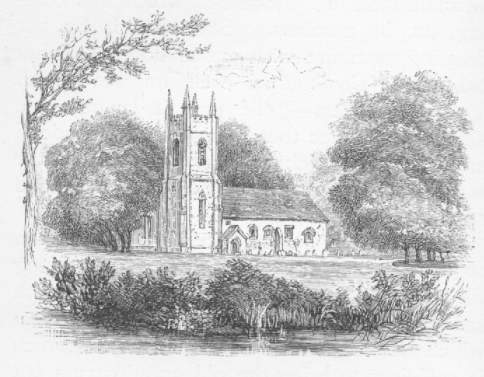
STOKE CHURCH
always given with a pitch-pipe. "Dame
Dutton's School" used to be ranged round the altar, and the
grand old alabaster tomb of Sir Reginald Corbet, and if any of
the children behaved ill during the service, they were turned up
and soundly whipped then and there, their outcries mingling oddly
with the responses of the congregation. But in those days, now
considered so benighted, there was sometimes real devotion.
People sometimes said real prayers even in church, before the
times since which the poor in village churches are so frequently
compelled to say their prayers to music. The curates always came
to luncheon at the Rectory on Sundays. They were always compelled
to come in ignominiously at the back door, lest they should dirty
the entrance: only Mr. Egerton was allowed to come in at the
front door, because he was "a gentleman born." How
Grannie used to bully the curates! They were expected not to talk
at luncheon, if they did they were soon put down. "Tea-table
theology" was unknown in those days. As soon as the curates
had swallowed a proper amount of cold veal, they were called upon
to "give an account to Mrs. Leycester" of all that they
had done in the week in the four quarters of the parish-Eton,
Ollerton, Wistanswick, and Stoke-and soundly were they rated if
their actions did not correspond with her intentions. After the
curates, came the school-girls to practise their singing, and my
mother was set down to strum the piano by the hour together as an
accompaniment, while Grannie occupied herself in seeing that they
opened their mouths wide enough, dragging the mouths open by
force, and, if they would not sing properly, putting her fingers
so far down their throats that she made them sick. One day, when
she was doing this, Margaret Beeston bit her violently. Mr.
Egerton was desired to talk to her afterwards about the
wickedness of her conduct. "How could you be such a naughty
girl, Margaret, as to bite Mrs. Leycester?" – "What'n
her put her fingers down my throat for? oi'll boite she harder
next time," replied the impenitent Margaret.
Grannie used to talk of chaney (china),
laylocks (lilacs), and gould (gold): of the Prooshians and the
Rooshians: of things being "plaguey dear" or "plaguey
bad." In my childhood, however, half my elders used such
expressions, which now seem to be almost extinct. "Obleege
me by passing the cowcumber," Uncle Julius always used to
say.
There were always three especial sources
of turmoil at Stoke, the curates, the butlers, and the gardeners.
Grannie was very severe to all her dependants, but to no one more
than to three young lady protégées who lived with her in
turn - Eliza Lathom, Emma Hunt, and Charlotte Atkinson - whom she
fed on skim-milk and dry bread, and treated so harshly that the
most adventurous and youngest of them, Charlotte Atkinson,16 ran away altogether, joined a party of
strolling players, and eventually married an actor (Mr. Tweedie).
I remember Grannie going down into the kitchen one day and
scolding the cook till she could bear it no longer, when she
seized the dinner-bell from the shelf and rang it in her ears
till she ran out of the kitchen. When there was "a wash"
at Stoke, which was about every third week, it was a rule with
Grannie that, summer or winter, it must always begin at one A.M.
At that hour old Hannah Berry used to arrive from the village,
the coppers were heated and the maids at work. The ladies-maids,
who were expected to do all the fine muslins, &c., themselves,
had also always to be at the washtubs at three A.M. - by
candlelight. If any one was late, the housekeeper reported to Mrs.
Leycester, who was soon down upon them pretty sharply. Generally,
however, her real practical kindness and generosity prevented any
one minding Mrs. Leycester's severity: it was looked upon as only
"her way;" for people were not so tender in those days
as they are now, and certainly no servant would have thought of
giving up a place which was essentially a good one because they
were a little roughly handled by their mistress. In those days
servants were as liable to personal chastisement as the children
of the house, and would as little have thought of resenting it.
"You don't suppose I'm going to hurt my fingers in
boxing your ears," said Grannie, when about to
chastise the school children she was teaching, and she would take
up a book from the table and use it soundly, and then say, "Now,
we mustn't let the other ear be jealous," and turn the child
round and lay on again on the other side. Grannie constantly
boxed her housemaids' ears, and alas! when he grew very old, she
used to box dear Grandpapa's, though she loved him dearly, the
great source of offence being that he would sometimes slyly give
the servant's elbow a tip when his daily table-spoonful of brandy
was being poured out.
As I have said, Grannie was quite
devoted to Grandpapa, yet as she was twenty years younger, his
great age could not but accustom her to the thought of his death,
and she constantly talked before him, to his great amusement, of
what she should do as a widow.
Judge Leycester ("Uncle Hugh"),
my grandfather's brother, had left her a house in New Street,
Spring Gardens, and whenever Mary Stanley went to Stoke, she used
to make her write down the different stages and distances to
London to be ready for her removal. Frequently the family used to
be startled by a tremendous ~ on the dining room door. Grannie
had ordered Richard, the young footman, up, and was teaching him
how
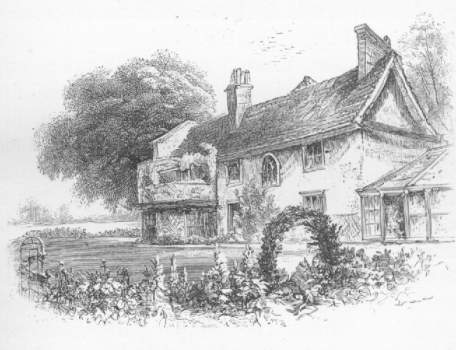
STOKE RECTORY-THE
GARDEN SIDE.
to give "a London knock" - it
was well he should be prepared. One day the party sitting in the
drawing-room were astonished to see the family carriage drive up
to the door, with Spragg the butler on the box. "I was only
seeing how Spragg will look as coachman when your Grandpapa is
dead," said Grannie, and Grandpapa looked on at the
arrangements and enjoyed them heartily.
As for dear Grandpapa himself he was
always happy. He would amuse himself for hours in touching up in
grey or brown his own (very feeble) sketches in Switzerland or
France. Being a great classical scholar, he also read a great
deal of Italian and Latin poetry, and addressed a Latin ode to
his daughter-in-law Lady Charlotte Penrhyn when he was in his
ninety-second year! This kind aunt of my childhood – "Aunt
Nin," as I always called her - was a very simple person,
utterly without pretension, but because she was Lord Derby's
daughter, Grannie always treated her as the great person of the
family. When we went to Stoke, no difference whatever was made in
the house, the stair-carpets were not laid down, and though the
drawing-room was constantly lived in, its furniture was all
swathed in brown holland after the fashion of an uninhabited
London house. When the Stanleys or Leycesters of Toft came to
Stoke, the stair-carpet was put down and the covers-covers were
taken off; but on the rare occasions when Aunt Penrhyn came to
Stoke – oh sublime moment! - the covers themselves were
taken off.
From our constant winter walk –
"the Rope Walk" - my mother and I could see Hodnet
Tower, of which Grandpapa had at one time been Rector as well as
of Stoke. Bishop Heber had been Rector before him, and in his
time my mother had found much of her chief happiness at Hodnet,
from sources which I did not understand, when I used so often to
walk up and down with her on Sundays, listening to the beautiful
Hodnet bells. In my childhood, Mrs. Cholmondeley was living at
Hodnet Hall, having been Mary Heber, the Bishop's sister. She was
very kind to me, writing for my instruction in English history a
"Chapter of Kings," of which I can only remember the
two last lines, which were rather irreverent:
"William the Fourth was a long
time sick, And then was succeeded by little Queen Vick."
It was a great event at Stoke when my
mother was allowed to have the carriage, though what John
Minshull the coachman generally did no one could ever find out.
If we drove, it was generally to Buntingsdale, a fine old brick
house of the last century standing at the end of a terraced
garden, with lime avenues above the Terne, near Market Drayton.
Here Mr. and Mrs. Tayleur lived with their four daughters - Mary,
Harriet, Lucy, and Emma, who were very severely brought up,
though their father was immensely rich. The old fashion was kept
up at Buntingsdale of all the daughters being expected to spend
the whole morning with their mother in the morning-room at work
round a round table, and formality in everything was the rule.
Yet many of my childish pleasures came from Buntingsdale, and I
was always glad when we turned out of the road and across some
turnip-fields, which were then the odd approach to the lime
avenue on the steep bank above the shining Terne, and to see the
brilliant border of crocuses under the old garden wall as we
drove up to the house. The eldest daughter, Mary, who looked then
like a delicate china figure and always smelt of lavender and
rose-leaves, used to show me her shell cabinet and her
butterflies, and teach me to collect snail-shells! The bright
energetic second daughter, Harriet, drew capitally and encouraged
my early interest in art. The other two daughters, Lucy and Emma,
died young, almost at the same time: my chief recollection is of
their bending over their eternal worsted-work, very pale and
fragile, and their passing away is one of my earliest impressions
of death.
The other neighbours whom we saw most of
were the Hills of Hawkestone, then a very numerous family. Five
of the brothers - Sir Rowland (afterwards Lord Hill), Sir Robert,
Francis; Sir Noel, and Colonel Clement were in the battle of
Waterloo, and my mother has often described to me the sickening
suspense in watching for the postman after the news of the
engagement had come, with the almost certainty that at least some
of the brothers must be killed. Miss Emma was deputed to receive
the news, as the sister of strongest nerve, but when she heard
that all her brothers were safe (only Sir Robert being slightly
wounded), she fainted away. Lord Hill used to ride to see my
Grandfather upon the charger he rode at Waterloo, which horse had
such a reputation, that people would come from great distances
more even to see the horse than Lord Hill himself. In earlier
days, the fiunfly at Hawkestone used to be likened to that of the
Osbaldistons in "Rob Roy" - and had all the same
elements - the chaplain, the soldiers, the sportsmen, the fox-hunter,
the fisherman, and in Rachel (daughter of the Colonel Hill who
was killed by a fall from his horse) a very handsome Diana Vernon,
with frank natural manners: people called her "the Rose of'Hawkestone."
My mother often used to recall how remarkable it was that though,
when gathered at home, the family seemed to have no other purpose
than to pursue the amusements of a country life, when called on
by their country to go forth in her service, none of her sons
were so brave, none more self-devoted, than the Hill brothers.
When all the family were at Hawkestone,
they dined early and had a hot supper at nine o'clock. As the
family interests were confined to sporting, the conversation was
not very lively, and was relieved by the uncles endeavouring to
provoke each other and the young ones-to yawn! no very difficult
task, seeing they had nothing to do. The eldest Miss Hill (Maria)
was a very primitive-looking person, with hair cut short, and
always insisted upon sitting alone at a side-table that no one
might see her eat; but I cannot remember whether she was alive in
my time, or whether I have only heard of her.
Even in the days of a comparative
inattention to those niceties of feminine attire now universally
attended to, the extraordinary head-gear worn by the Misses Hill,
their tight gowns, and homely appearance, were matter for general
remark. But if they lacked in these points, they vied with their
brothers in the possession of brave hearts and loving sympathies
– "Every eye blessed them: every tongue gave witness"
to their active benevolence.
In true patriarchal style, the six
children of the eldest of the Hill brothers were brought up with
the uncles and aunts at Hawkestone Hall, nor was any change made
when the father's sudden death left a young widow to be tended
with all the kindness of real brethren in the old family home. At
length the grandfather died, and Sir Rowland, then about eighteen,
succeeded. But when his affairs were inquired into, it was found,
that in consequence of very serious losses in a county bankruptcy
and -from mismanagement of the estate, there was a heavy debt
upon the property, which, at best, it would take years to
liquidate. A plan of rescue presented itself to Mrs. Hill, the
young baronet's mother, who was a clever and kindhearted woman,
but lacked the simplicity of her sisters-in-law. A rich merchant,
a Mr. Clegg from Manchester, had bought the estate adjoining
Hawkestone. His only granddaughter was then scarcely more than a
child; but it was as great an object of desire to old Mr. Clegg
to ally his child with an ancient and respected family and to
procure for her the rank and station which his gold could not
obtain, as it was to Mrs. Hill to replenish her son's empty
treasury, and enable him to keep up the family place. A compact
for the future was soon settled. In a few years, however, the
fatal illness of Mr. Clegg obliged Mrs. Hill to hurry matters,
and over her grandfather's deathbed Sir Rowland was married to
the girl of fifteen. Immediately after the ceremony Mr. Clegg
died. Mrs. Hill then took the girl-bride home, and educated her
with her own niece, no one suspecting her secret. Sir Rowland
went abroad. When two years had elapsed, Mrs. Hill also went
abroad with "Miss Clegg" - who returned as the wife of
Sir Rowland, received with great festivities. The marriage was a
most happy one. The unassuming gentleness of the lady was as
great as if she had been born in the station to which she was
called: and in the charities of social and domestic life and the
exercise of the widest-hearted benevolence to all around her, she
long reigned at Hawkestone.17 Her son Rowland was only a year
older than myself, and was the nearest approach to a boy-acquaintance
that I had quite as a child.
Hawkestone was and is one of the most
enchanting places in England. There, the commonplace hedges and
fields of Shropshire are broken by a ridge of high red sandstone
cliffs most picturesque in form and colour, and overgrown by old
trees with a deep valley between them, where great herds of deer
feed in the shadow. On one side is a grotto, and a marvellous
cavern-" the Druid's Cave "-in which I used to think a
live Druid, a guide dressed up in white with a wreath, appearing
through the yellow light, most bewildering and mysterious. On the
other side of the valley rise some castellated ruins called
"the Red Castle." There was a book at Stoke Rectory
about the history of this castle in the reign of King Arthur,
which made it the most interesting place in the world to me, and
I should no more have thought of questioning the fight of Sir
Ewaine and Sir Hue in the valley, and the reception of the former
by "the Lady of the Rock," and the rescue of Sir
Gawaine from the gigantic Carados by Sir Lancelot, than I should
have thought of attacking-well, the divine legation of Moses. But
even if the earlier stories of the Red Castle are contradicted,
the associations with Lori Audley and the battle of Blore Heath
would always give it a historic interest.
Over one of the deep ravines which ran
through the cliff near the Red Castle was "the Swiss Bridge"
- Aunt Kitty painted it in oils. Beneath it, in a conical summer-house
– "the Temple of Health" - an old woman used to
sit and sell packets of ginger-bread – "Drayton ginger-bread"
- of which I have often bought a packet since for association's
sake.
But the most charming expedition of all
from Stoke was when, once every year, I was sent to pay a visit
to the Goldstone Farm, where the mother of my dear nurse Mary Lea
lived. It was an old-fashioned farmhouse of the better class,
black and white, with a large house-place and a cool parlour
beyond it, with old pictures and furniture. In front, on the
green, under an old cherry-tree, stood a grotto of shells, and
beyond the green an open common on the hillside covered with
heath and gorse, and where cranberries were abundant in their
season. Behind, was a large garden, with grass walks and
abundance of common flowers and fruit. Dear old Mrs. Lea was
charming, and full of quaint proverbs and sayings, all, as far as
I remember them, of a very ennobling nature. With her lived her
married daughter, Hannah Challinor, a very fat good-natured
farmeress. Words cannot describe the fuss these good people made
over me, or my own dear Lea's pride in helping to do the honours
of her home, or the excellent tea, with cream and cakes and jam,
which was provided. After Mrs. Lea's death, poor Mrs. Challinor
fell into impoverished circumstances, and was obliged to leave
Goldstone, though the pain of doing so almost cost her her life.
I was then able for many years to return in a measure the
kindness shown me so long before.
Long after the railway was made which
passed by Whitmore (within a long drive of Stoke), we continued
to go in our own carriage, posting, to Shropshire. Gradually my
mother consented to go in her own carriage, on a truck, by rail
as far as Birmingham; farther she could not endure it. Later
still, nearly the whole journey was effected by rail, but in our
own chariot. At last we came to use the ordinary railway
carriages, but then, for a long time, we used to have post-horses
to meet us at some station near London: my mother would not be
known to enter London in a railway carriage – "it was
so excessively improper" (the sitting opposite strangers in
the same carriage); so we entered the metropolis "by land,"
as it was called in those early days of railway travelling.
On returning to Lime, in the spring of
1841, I was sent to Mr. Green's school, a commercial school at
Windmill Hill, about a mile off I used to ride to the school on
my little pony "Gentle," much to the envy of the
schoolboys; and in every way a most invidious distinction was
made between me and them, which I daresay would have been
thoroughly avenged upon me had I remained with them during play-hours;
but I was only there from nine to twelve, doing my lessons at one
of the, great oak desks in the old-fashioned schoolroom. I
chiefly remember of the school the abominable cases of
favouritism that there were, and that if one of the ushers took a
dislike to a boy, he was liable to be most unmercifully caned for
faults for which another boy was scarcely reproved. In the autumn,
when we went to Rockend, I was sent to another school at Torquay,
a Mr. Walker's, where I was much more roughly handled, the master
being a regular tartar. I remember a pleasant, handsome boy
called Ray, who sat by me in school and helped me out of many a
scrape, but Mr. Walker was very violent, and as he was not
allowed to beat me as much as he did the other boys, he soon
declined teaching me at all.
The railway from London to Brighton was
now just opened, and we took advantage of it. As we reached
Merstham (by the first morning train) the train stopped, and we
were all made to get out, for the embankment had fallen in in
front of us. It was pouring in torrents of rain, and the line
muddy and slippery to a degree. We all had to climb the slippery
bank through the yellow mud. I was separated from my mother and
Lea and Uncle Julius, who was with us, but found them again in a
desolate house, totally unfurnished, where all the passengers by
the train were permitted to take refuge. It was the place whither
I have gone in later days to visit Lord Hylton. Here we sat on
the boarded floor, with very little food, in a great room looking
upon some dripping portugal laurels, all through the long weary
day till four in the afternoon, when omnibuses arrived to take us
to another station beyond the broken line. We did not reach
Brighton till nine P.M., and when we arrived at the station and
inquired after our carriages, which were to have met us at mid-day
and taken us home, we heard that a bad accident had taken place;
one of the horses had run away, one of the carriages been
overturned down a steep bank, and one of the servants had his arm
broken. We remained at Brighton in some anxiety till Monday, when
we found that it was my uncle's horse – "Steady"
which had run away, and his faithful old servant Collins who was
injured.
When my uncle was driving himself, these
accidents were so frequent that we scarcely thought anything of
them, as he drove so carelessly and talked vehemently or composed
his sermons or charges all the way. But if the family had an
accident on their way to church, they always returned thanks for
their preservation, which made quite a little excitement in the
service. I remember one occasion on which my mother and aunt did
not appear as usual, when a note was handed to Uncle Julius as he
came out of the vestry, upon which thanks were returned for the
"merciful preservation of Lucy and Maria Hare and Staunton
Collins" (the coachman) - and all the Rectory servants and
all the Lime servants immediately walked out of church to look
after the wounded or - because they were too excited to stay! The
horse had taken fright at a gipsy encampment in the marsh lane
and the family had been precipitated into the ditch.
At this time Uncle Julius had been made
one of the Poor Law Guardians and had to visit at the workhouse,
and there was the most ceaseless ferment and outcry against him.
All sorts of stories were got up. One was that he was going to
put all the children into a boat and take them out to sink them
in Pevensey Bay! One day old Betty Lusted went up to the Rectory
and asked to see the Archdeacon. He went out to her: "Well,
Betty, and what do you want ?" – "I want to know,
zur, if you do know the Scripture." – "Well, Betty,
I hope I do, but why do you ask ?" – "Because if
you do know the Scripture, how coomes it that you doona
zee them whom God hath joined together let na man put asunder'?"
(apropos of the separation of husbands and wives in the workhouse);
and though she was a poor halfwitted body, she brought the tears
into his eyes. I remember his asking her daughter Polly once what
she prayed for every night and morning. "Well, zur, I do
pray for a new pair of shoes," replied Polly, without the
slightest hesitation.
Uncle Julius would have given the world
to have been able to talk easily and sympathetically to his
people, but he could not get the words out. Sick people in the
parish used to say, "The Archdeacon he do come to us, and he
do sit by the bed and hold our hands, and he do growl a little,
but he do zay nowt."
One day he heard that a family named
Woodhams were in great affliction. It was just after poor Haydon
had committed suicide, and he took down Wordsworth's sonnet on
Haydon, and read it to them by way of comfort. Of course they had
never heard of Haydon, and had not an idea what it was all about.18
It was on our way from Norwich to Stoke
in the autumn of 1841 that I made my first sketch from nature. We
slept at Bedford, to meet Charles Stanley there, and I drew
Bedford Bridge out of the window - a view made by candlelight of
a bridge seen by moonlight - but it was thought promising and I
was encouraged to proceed. My mother, who drew admirably herself,
gave me capital simple lessons, and in every way fostered my love
of the picturesque. Indeed Hurstmonceaux itself did this, with
its weird views across the levels to the faint blue downs, and
its noble ruined castle. Of the stories connected with this
castle I could never hear enough, and Uncle Julius told them
delightfully. But the one I Cared for most was of our remote
ancestress Sybil Filiol, who lived at Old Court Manor in the
reign of Edward II., I think. Uncle Julius used to describe how,
after her marriage in Wartling Church, she went to take leave of
her dead father's garden (before riding away upon a pillion
behind her husband), and, whilst there, was carried off by
gipsies. Her husband and other members of her family pursued them,
but in those days locomotion was difficult, escape in the Cheviot
Hills easy, and she was never heard of again.19 How well I remember the pictorial
description of a strange funeral seen approaching over the hills
– "the gipsies of the north" bringing back the
body of Sybil Filiol to be buried with her ancestors at Wartling,
and the story of how her husband devoted her dowry to making
"Sybil Filiol's Way," a sort of stone causeway to
Hurstmonceaux Church, of which I delighted to trace the old grey
stones near Boreham Street and in the Church Lane.
Our cousin Anna Maria Shipley, who had
been cruelly married by her father against her will to the savage
paralytic Mr. Dashwood, and who had been very many years a widow,
had, in 1838, made a second marriage with an old neighbour, Mr.
Jones, who, however, lived only a year. In 1840, she married as
her third husband the Rev. George Chetwode, and died herself in
the year following. Up to the time of her death, it was believed
and generally understood that the heirs of her large fortune were
the children of her cousin Francis,20 but it was then discovered that
two days before she expired, she had made a will in pencil in
favour of Mr. Chetwode, leaving all she possessed in his power.
This news was an additional shock to my father, who had never
recovered the will of Mrs. Louisa Shipley, and he passed the
winter of 1841 at Palermo in the utmost melancholy. When be first
arrived, he gave a few dinners, but after that, says Victoire, he
seemed to have a presentiment of his end, though the doctors
declared that he was not dangerously ill. For several nights in
February Félix sat up with him. Mr. Hare wished to send him to
bed, "mais Félix repondit, 'Rappelez-vous, monsieur, que je
suis ancien militaire, et que quand j'ai une consigne, je ne la
quitte jamais;" and then he opposed Félix no longer. "One
morning at five o'clock A.M.," said Madame Victoire, "he
asked Félix what o'clock it was. Félix told him. Then he said,
'Dans une demi-heure j'aurais mon lait d'ânesse,' parceque l'ânesse
venait à six heures. . . Puis il commence à faire jour, et Félix
se met à arranger un peu la chambre. Se trouvant à la fenêtre,
il entend M. Hare faire un mouvement dans le lit: Félix regarde
de près, il écoute, il touche: M. Hare venait de finir."
My father was buried in the English
Cemetery at Palermo, where there is a plain sarcophagus over his
grave. The English Consul sent the following certificate to Mrs.
Hare
"On Saturday, the 15th January,
1842, the remains of the late Francis George Hare, Esquire, were
interred in the Protestant Burial Ground at the Lazzaret of
Palermo, in the presence of a large concourse of Sicilian
noblemen, and of the British, French, and American residents. The
service of the church was read by the Rev. W. F. Holt, and the
pall was supported by the Principino of Lardoria, the Prince of
Radali, the American Consul, and Mr. J. F. Turner.
As a token of respect to the memory of
the deceased, the flags of the British; French, and American
vessels were hoisted half-mast high during the forenoon."
The summer was spent by the Marcus Hares
at the Rectory - one of those intensely hot summers which I never
remember since my childhood, when we gasped through the day, and
lay at night under bowers of ash-boughs to keep off the torment
of gnats, which used then to be as bad at Hurstmonceaux as I have
since known mosquitoes in Italy. Of my cousins I preferred
Theodore, who was a very engaging little child. I remember Uncle
Julius coming out with tears streaming down his cheeks, and an
open letter in his hand, one day when all the family were sitting
under the trees. It was the news of the death of Dr. Arnold of
Rugby.
In the autumn Mrs. Hare came with her
children to spend some time at Hurstmonceaux Rectory. It was then
arranged that I should call her "Italima" (being a
corruption of "Italian Mama"), and by that name I will
henceforth speak of her in these memoirs, but this must not be
taken to imply any greater intimacy, as she never treated me
familiarly or with affection. I remember the party arriving in
their black dress - Italima, Francis, William, Esmeralda, Mr.
Gaebler - the admirable tutor, Félix, Victoire, and Clémence -
my sister's maid. My sister, as a little child, was always called
"the Tigress," but as she grew older, her cousin Lord
Normanby remonstrated at this. "Then give her another name,"
said Italima. "Esmeralda," -and Esmeralda she was now
always called.
Italina must have found it intensely
dull at the Rectory. She used to walk daily to Gardner Street,
where the sight of "somebody" and the
village shops was a consolation to hen She used to make my sister
practise on the pianoforte for hours, and if she did not play
well she shut her up for the rest of the day in a dressing-room,
and I used to go and push fairy-stories to her under the door
Though she was so severe to my sister, she resented exceedingly
any scoldings which Uncle Julius gave to Francis, who richly
deserved them, and was terribly spoilt. He was, however, as
beautiful as a boy as my sister was as a girl, and a wonderfully
graceful pair they made when they danced the tarantella together
in the evenings. Altogether my own brothers and sister being as
children infinitely more attractive than the Marcus Hares', I was
much happier with them, which was terribly resented in the family,
and any sign I gave of real enjoyment was always followed by some
privation, for fear I should be over-excited by it. Mr. Gaebler
was a most pleasant and skilful tutor and I found it delightful
to do lessons with him, and made immense progress in a few weeks:
but because his teaching was pleasant, it was supposed
that the "discipline" of lessons was wanting, and I was
not long allowed to go on learning from him. In the afternoons we
were all made to go to the school and practise ridiculous Hullah
singing, which we loathed.
The Bunsens were now living at
Hurstmonceaux Place. Bunsen had been Minister for Prussia at Rome
at the time of my birth and the death of my uncle Augustus Hare,
and had then become very intimate with my mother, as he had
previously been with my uncle. Therefore, when be became Minister
in London and wanted a country-house, Hurstmonceaux Place, which
was then to let, seemed wonderfully suited to his requirements.
The great distance from London, however (the railway then coming
no nearer than Brighton, twenty-four miles off) prevented the
Bunsens from remaining more than two years at Hurstmonceaux; but
during this time they added much to our happiness, and, child as
I was, I was conscious of the vivifying influence which their
refinement, their liberal views, and high-toned conversation
brought into the narrow circle at Hurstmonceaux, which being so
much and so often cut off from outer influences, was becoming
more and more of a Mutual Admiration Society. In the many loving
daughters of the house, my mother found willing helpers in all
her work amongst the poor, while the cheerful wisdom and
unfailing spirit of Madame Bunsen made her the most delightful of
companions. For several months I went every morning to
Hurstmonceaux Place, and did all my lessons with Theodore Bunsen,
who was almost my own age, under the care of his German tutor,
Herr Deimling.
It must have been in 1841, I think, that
Bunsen inoculated my uncle and mother with the most enthusiastic
interest in the foundation of the Bishopric of Jerusalem, being
himself perfectly convinced that it would be the Church thus
founded which would meet the Saviour at his second coming. Esther
Maurice, by a subscription amongst the ladies of Reading,
provided the robes of the new Bishop;
In the spring of 1843 I was dreadfully
ill with the whooping-cough, which I caught (as I had done the
chicken-pox before) from my mother's numerous parochial
godchildren, when they came to Lime for their lessons. When I was
better we went for three days in our own carriage to the Mount
Ephraim Hotel at Tunbridge Wells. It was my first "tour,"
and it was with rapture that I saw Mayfield Palace, Bayham Abbey,
and the High Rocks, on our way to which Lea and I were run away
with by our donkeys.
When the Marcus Hares were not at the
Rectory, Uncle Julius in these years had a wonderfully varied
society there, of whom we always saw more or less - German
philosophers, American philologists, English astronomers,
politicians, poets. Amongst those I particularly disliked were
Whewell and Thirlwall - so icily cold were their manners. Bunsen,
Star, Archdeacon Moore, Prentiss the American, Darley, Hull, I
liked; but Professor Sedgwick I was quite devoted to.21 He "threw a mantle of love
over everyone;"22 and nothing could be more charming than his
stories, more attractive and interesting than his conversation,
especially with children, with whom he took pains to "be
agreeable." I saw so many people of this kind, that I used
to think that what I heard called "society" was all
like these specimens: I was very much mistaken. A visit from the
gentle and amiable Copley Fielding early encouraged my love of
art. He greatly admired the peculiar scenery of Hurst-
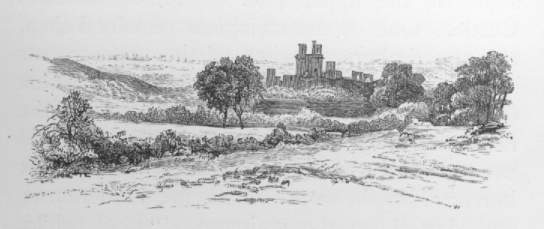
HURSTMONCEAUX.
monceaux - the views from the churchyard,
so like the descent upon the marshes of Ostia; the burnt uplands
of the old deer-park; the long flat reaches of blue-green level;
and the hazy distant downs, which were especially after his own
heart. There was one view of the castle towers seen from behind,
and embossed against the delicate hues of the level, which he
used to make a frequent study of; and which my mother and uncle
ever after called "Copley Fielding's view."
Amongst other visitors of this year, I
must mention our cousin Penelope, - Mrs. Warren (eldest daughter
of Dean Shipley and sister of Mrs. Dashwood and Mrs. Heber), who
spent some days at the Rectory with her daughters, because under
her protection I had my only sight of the upper part of
Hurstmonceaux Castle. One of the staircases remained then, and
the timbers of many of the upper rooms were left, though the
floors were gone. One day we were with my mother and uncle in the
ruins, and they were saying how no one would ever see the upper
floor again, when, to their horror, Mrs. Warren seized me in her
arms and darted up the staircase. "Look, child, look!"
she said, "for no one will ever see this again," and
she leapt with me from beam to beam. I recollect the old chimney-pieces,
the falling look of everything. It was wonderful that we came
down safe; the staircase was removed immediately after, that no
one might follow in our footsteps.
I remember Carlyle coming to stay at the
Rectory, where they did not like him much. He came in a high hat-every
one wore high hats then. The day he arrived, the wind blew his
hat off into a ditch as he was getting over a stile: and he went
off at once into one of his unbounded furies against "the
most absurd outrageous head-covering in the world, which the
vanity of the Prince Regent had caused people to adopt."
Aunt Lucy and the Maurices had long
urged my mother to send me to school, and perhaps in many ways my.
terrible fits of naughtiness made it desirable, though they
chiefly arose from nervousness, caused by the incessant "nagging"
I received at home from every one except my mother and Lea. But
the choice of the school to which I was sent at nine years old
was very unfortunate. When illness had obliged my Uncle Augustus
Hare to leave 'his beloved little parish of Alton Barnes for
Italy, a Rev. Robert Kilvert came thither as his temporary curate-a
very religious man, deeply learned in ultra "evangelical"
divinity, but strangely unpractical and with no knowledge
whatever of the world-still less of the boyish part of it. As Dr.
John Brown once said – "The grace of God can do muckle,
but it canna gie a man common-sense." Mr. Kilvert was a good
scholar, but in the dryest, hardest sense; of literature he knew
nothing, and he was entirely without originality or cleverness,
so that his knowledge was of the most untempting description.
Still his letters to my mother in her early widowhood had been a
great comfort to her, and there was no doubt of his having been a
thoroughly good parish-priest. He had lately married a Miss
Coleman, who derived the strange name of Thermuthis from the
daughter of Pharaoh who saved Moses out of the bulrushes, and he
had opened a small school at his tiny Rectory of Hardenhuish, or,
as it was generally called, Harnish, the estate of the
Clutterbucks, near Chippenham in Wiltshire; so my mother,
thinking it of far more importance to select "a good man"
than "a good master," determined 'to send me there. How
often since have I 'seen the terrible mistake of parents in
"packing off" children to a distant school, to be
entirely in the hands of masters of whose practical influence and
social competence for their duties they know nothing whatever!
My own experience of Harnish is one of
the many instances I have known of how little the character of
the head of an establishment affects the members of it, unless
his spirituality is backed up by a thorough knowledge of the
world. The greater portion of Mr. Kilvert's scholars-his "little
flock of lambs in Christ's fold" - were a set of little
monsters. All infantine immoralities were highly popular, and -
in such close quarters - it would have been difficult for the
most pure and high-minded boy to escape from them. The first
evening I was there, at nine years old, I was compelled to eat
Eve's apple quite up - indeed, the Tree of the Knowledge of Good
and Evil was stripped absolutely bare: there was no fruit left to
gather.
I wonder if children often go through
the intense agony of anguish which I went through when I was
separated from my mother. Perhaps not, as few children are
brought up so entirely by and with their parents in such close
companionship. It was leaving my mother that I minded, not the
going to school, to which my misery was put down: though, as I
had never had any companions, the idea of being left suddenly
amongst a horde of young savages was anything but comforting. But
my nervous temperament was tortured with the idea that my mother
would die before I saw her again (I had read a story of this kind),
that our life was over, that my aunts would persuade her to cease
to care for me, - indeed, the anguish was so great and so little
understood, that though it is more than fifty years ago, as I
write this, I can scarcely bear to think of it.
1 See
the chapter called "Home Portraiture" in "Memorials
of a Quiet Life."
2 Edward
Leycester had taken the name of Penrhyn with the fortune of his
father's cousin, Lady Penrhyn of Penrhyn castle. His wife was
Lady Charlotte Stanley, daughter of the 13th Earl of Derby.
3 Second
daughter of Sir John Stanley, afterwards 1st Lord Stanley of
Alderley, and niece of the Rev. Edward Stanley, Maria Leycester's
brother-in-law.
4 Edward
Stanley, Rector of Alderley and afterwards Bishop of Norwich, had
married my mother's only sister, Catherine Leycester ("Kitty"),
who was seven years older than herself
5 'C
Maurice was by nature puzzle-headed, and, though in a beautiful
manner, wrong-headed; while his clear conscience and keen
affections made him egotistic, and, in his Bible reading, as
insolent as any infidel of them all." - Ruskin, "Prateritir."
6 R. Holt Hutton.
7 The child was only
three.
8 George Herbert.
9 This
half-aunt of mine was living in 1894, having long been the widow
of the Rev. F. D. Maurice. I had not seen her for more than
thirty years before her death. I could not say I adored all the
Maurices: it would have been an exaggeration. So she did not wish
to see me.
10 The
Rev. R. Chenevix Trench, afterwards Archbishop of Dublin. The
fact was, his were very pleasant children, and therefore I liked
them; but I was expected to like all children, whatever their
characters, and scolded if I did not.
11 My uncle Julius Hare's
Recollections.
12 From
the notes of Francis Hare's life by Madame Victoire Ackermann.
13 See Crabbe Robinson's
Diary.
14 He died Rector of
North Creake, April 1894.
15 Merry wives of
Windsor.
16 Afterwards Mrs.
Chatterton.
17 Ann, Viscountess Hill,
died Oct.31, 1891.
18 Recollections of
Canon Venables, his sometime curate.
19 Long afterwards I
learned that it is recorded in legal proceedings, how Giles de
Fienes (of Hurstmonceaux) brought a suit against Richard de
Pageham for the violent abduction of his wife Sybil, daughter of
William Filiol, on August 30, 1223. I suppose Richard employed
the gipsies as his intermediaries.
20 She had told Landor
so.
21 The Rev. Adam
Sedgwick, Prebendary of Norwich and Woodwardian Professor of
Geology, died Jan.27, 1873.
22 Mrs. Vaughan.